When you read the first two pages you got a lot of insight on the construction and the repairing of these forts, we found there was not always a lot of money to keep the work going and when there was funds it was slow coming. The work would come to a stop, some times because of sickness and storms, but in the end, these hardy men got the job done. Page two left off in the year of 1836, page three will take up again in 1836,and will end in 1838, But this will not be the end, I will be adding links to some maps to a few forts these should be of real interest to those of you who are researching forts. I will also be adding a list of all the fort names I can find, this too should be of a real interest to you fort researchers.
Important Note. On opening any of these address you will find a enlarging box in the lower right hand corner of the page just move your arrow around the box will come up then just push on it.
Fort Adams, Narraganset Roads, Rhode Island.
In a report of 1837, it states, Most of the excavation and embankments, both rock and earth, and a grate portion of the masonry, have been completed, and progress has been made in flooring, partitioning, and plastering the casements along the face of the northeast bastion. There yet remain to be finished portions of the glacis and of the earthen parapets, a small part of the scarps of the north and the west fronts, the remainder of the parade wall, al the breast height-walls, part of the permanent wharf above the water, the interior of the quarters and store-rooms, the gun platforms, and a considerable portion of the redoubt.
Note. The meaning of:
Redoubt, A temporary fortification built to defend a position such as a hilltop.
Glacis, a slope in front of a fortification designed to make it easier to fire on attacking forces.
Parapets, a bank of earth, rubble, or sandbags piled up along the edge of a military trench for protection from enemy fire.
Scarp, a steep slope, for example, the inner wall of a ditch, in front of a fortification.
Fort Calhoun, Hampton Roads, Virginia.
In a report in 1837, it stated, In Accordance with previous instructions, the remainder of the stone was this year nearly removed from the foundation of the work, preparation to commencing the masonry. A board of engineers appointed in September to inspect it, recommended however, in the strongest terms, on account of the continued subsidence, the reloading of the foundations, accordingly, with the sanction of the proper department, instructions to the effect were immediately issued, and the reloading is now in progress.
Castle William, New York.
In a report of 1837, it states, The sea has lately made encroachments upon the base of Castle William, which should be protected at an early day by a substantial sea wall. The old sea wall around the Island requires repairing; five thousand dollars would put it in a state of tolerable security. Stone for traverse circles, and Iron plates for the same, are yet wanted; and two wharves on Buttermilk channel require repair.
Fort Caswell, Oak Island, North Carolina.
The report of 1837, states, Since September 30, last 1,360 cubic yards masonry have been constructed, and 13,038 cubic yards of earth removed; the sheet piling has been driven around the foundations of two colonizers, and a considerable portion of the lead-roofing has been laid. The masonry constructed comprises the greater part of the counter forts and relieving arches intended to strengthen the scarp walls, the breast-height walls of the covered way of the gorge, and of face No.4, and he permanent tide lock. The effect of a storm in August last has been such as to prove conclusively the necessity of protecting the site of this fort from the sea abrasion, which has been progressing for several years.
In a report of January 8, 1838, it states, The site of Fort Caswell, Oak Island, North Carolina, is now exposed to destruction from the storm-waves and tides that are abrading the beach. The effects of a late gale were so perceptible as to cause considerable apprehension, unless timely measures were taken for its preservation.
Fort Coffee Arkansas River.
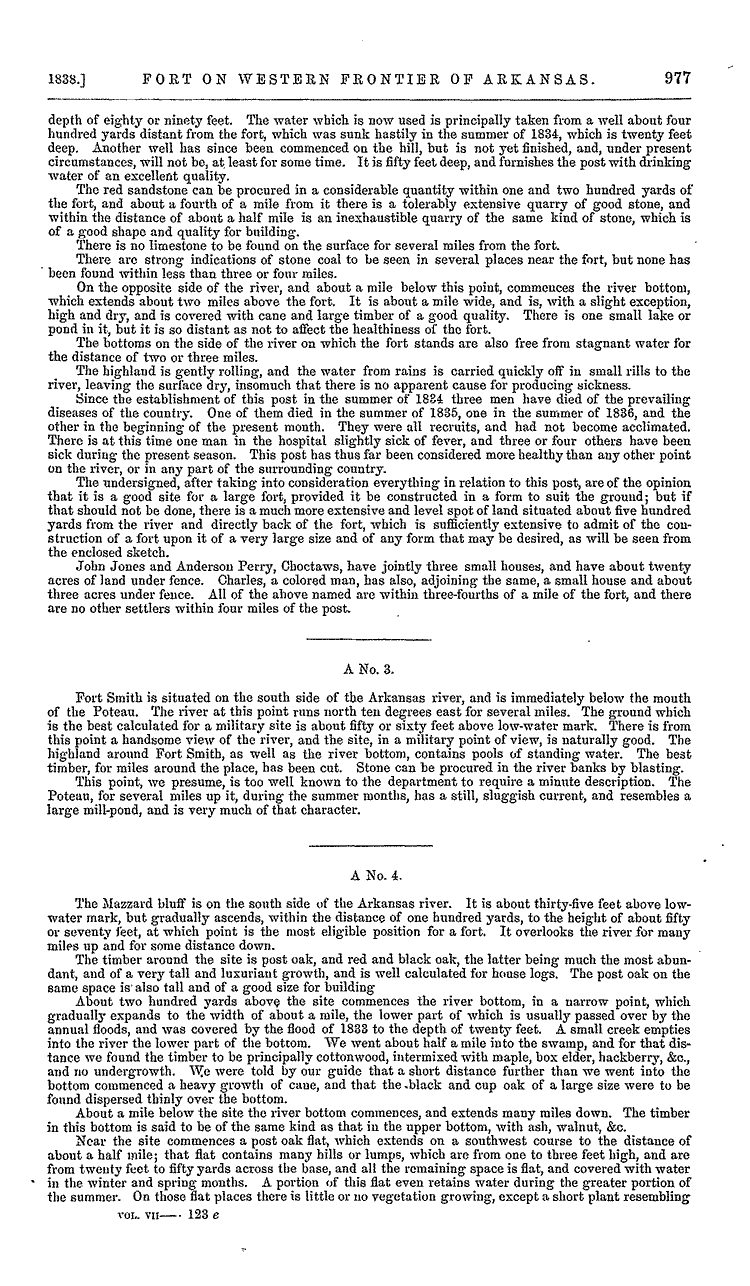
This information is way to long to put here however these address will take you to the information there will be three maps that goes with the information. The information talks of the land and more, this information is two pages long.
Fort Coffee.
1. http://memory.loc.gov/ll/llsp/022/0900/09920976.gif
2. http://memory.loc.gov/ll/llsp/022/0900/09960977.gif
Maps.
1. http://memory.loc.gov/ll/llsp/022/0900/09930000.gif
2. http://memory.loc.gov/ll/llsp/022/0900/09940000.gif
3. http://memory.loc.gov/ll/llsp/022/0900/09950000.gif
Fort Delaware, Delaware River.
In a report of 1837, it was stated, No exertion were spared to hasten this work the past year, so far as could advantageously be done. It was continued till suspended by the ice in December. Little however, was accomplished in consequence of the late appropriations; of the unusually high price of labor and materials of all kinds.
Driving piles for foundations, in consequence of the nature of the soil, these piles are of the grate length forty-five feet. A grate improvement has this season been introduced in the method of driving them, by the substitution of steam power for that of horses; more then fifteen piles per day, on an average, are driven with one pile-engine, which, when worked drove only three per day; it is found too, that from the continuous tremulous motion imparted by the engine, the pile can drive, not only with grater rapidity, but to a grater depth, without injury. The number of piles driven during the season, up to September 30, is 5,353, the work of about five months, commencing with one engine and never working more then three. The grate importance of this change becomes evident when it is considered that at the commencement of the season there were twelve thousand piles to drive. There are now driven the foundations for two fronts and the others are rapidly progressing.
Fort on Foster’s Bank, Florida.
The report of 1837, states, It was to have been completed in the month of October. Its site is now considered secure from any inroads of the sea, having been exposed in August last to a very server gale, from which it sustained no injury. Several parts of the work, subject to the pressure of the arches, have been increased in their dimensions, and the terreplein covered with a terrace of masonry nine inches thick. Twelve rooms have been fitted up in the casemates for officers quarters, and six large ones for the soldiers.
Fort Independence, Boston Harbor, New York.
In a report of 1837, it states, About one hundred and thirty mechanics and laborers have been employed during the past season at this work; eight thousand one hundred and seventy-two cubic yards of masonry have been laid, comprising the foundation of the scarp walk along two whole fronts, and part of two others; the superstructure of the same in part completed along two fronts, and twenty of the piles of the casemates on the channel fronts nearly completed. The embrasures of on the channel fronts are finished.
Fort King, Florida.
In a report of 1836, it was said, A detachment of regulars and volunteers has just arrived at Fort King from Fort Brooke, and will remain till further orders. Brigadier General Clinch or the command officer will immediately hire or employ any suitable boats which are found at or near Payne’s landing, to be sent down with a sufficient detachment to receive at Picolata, or if met, from a steamer which will be dispatched to the mouth of the Ocklawaha, the subsistence which will be wanted at Fort King.
Fort Livingston, Grande Terre, Louisiana.
The report of 1837, states, Operations have been suspended at this work during the last year for want of an officer to superintend it. A keeper and one man are employed to take care of the public property and make sundry small improvements near the site of the work.
Fort McHenry, Baltimore harbor, Maryland.
In a report of 1837, states, The parapet of the fort has been strengthened by a brick revetment wall, the scarp wall has been thoroughly repaired, the quarters new floored, painted and roofed, an additional battery nearly completed, one thousand three hundred feet of the sea wall built, and fifteen acres of land purchased.
Note. Meaning of:
Parapet, A bank of earth, rubble, or sandbags piled up along the edge of a military trench for protection from enemy fire.
Fort Mifflin, Delaware River, Pennsylvania.
In a report of 1837, it was stated, The present year a gun-shed has been erected, the terreplein of the fort has been graduated and graveled, pavements have been made about the quarters, some necessary outbuildings erected, and all the wood work of the building painted; a mess-house and mess-room are now fitting up, and on their completion, the fort will be ready to receive a garrison
Note. Meaning of:
Terreplein, a raised embankment or platform behind a parapet where heavy guns are positioned.
Fortifications in Charleston harbor, Fort Moultrie.
In the report of 1837, it states, The department having no officer at its disposal for the superintendence of these works, they have been suspended, with the exception of the labor for the preservation of the site of Fort Moultrie.
Fort Pulaski, Cockspur Island Georgia.
The report of 1837, states, The Operation at this fort, after preparations were completed in October 1836, consisted principally in laying masonry of the rampart, embanking the parade, preservation of the Island on the north and northeast shore by a breakwater and catch-sand, and constructing the permanent dikes of the Island; The masonry have been laid in completing all the embrasures and piers, masonry have been laid in completing all the embrasures and piers north and northeast fronts; completion generally of piers and embrasures, walls &c., of the gorge, to the level of the bottom of casement floors, construction of the breakwater and permanent dikes.
Fort Schuyler, Throg’s Neck, East river, New York.
In a report of 1837, it states, By the purchase of a second steam boat and other auxiliaries, operation have been greatly facilitated at this work, and are now making very satisfactory progress. The sea wall has been finished, with the exception of a small part of the coping, the foundations of a considerable portion of the scarp and counter scarp walls and piles of casements laid, and the superstructure commenced. The grater part of the embankment of the glacis and part of the rampart of the cover face have been formed.
Fort Smith, Arkansas.
In a report of 1838, it was stated, Fort Smith is situated on the south side of the Arkansas river, and is immediately below the mouth of the Poteru. The river at this point runs north ten degrees east for several miles. The ground which is best calculated for a military site is about fifty or sixty feet above the low-water mark. There is from this point a handsome view of the river, and the site, in a military point of view, is naturally good. The highland around Fort Smith, as well as the river bottom, contains pools of standing water. The best timber, for miles around the place, has been cut. Stone can be procured in the river by blasting.
Note. Here is a map showing Fort Smith.
http://memory.loc.gov/ll/llsp/022/0900/09950000.gif
Fort Warren, Boston harbor, Massachusetts.
The report of 1837, states, Operations were resumed at this work the first of April. The average force employed has been two hundred and forty mechanics and laborers. Up to September 20, there had been laid nine thousand four hundred and seventy-eight cubic yards of stone work, in pies and scarp walls; and two thousand seven hundred and fifty-five cubic yards of brick-work, containing 1,781,000bricks; eight hundred and fifty running feet of scarp wall have been carried up sixteen feet above the ditch it along the two channel fronts, and part of another; the piers and arches of nineteen casemates are completed, twelve of which are thirty feet span, and seven smaller. The piers of the other casemates are so far advanced that all the arches for the two channel fronts may be completed the next year.
Note. This is the end of the construction and repairing reports but not the end of the information. Below you will find Fort maps and a list of fort names.
------------------------------------------------------------------------------------
Important note. You will find on opening these address’s that the map or information may be small and hard to read not to worry there is a enlarging box in the lower right hand corner of the page just move your arrow around it will come up, then push on it.
Maps.
1. Fort Clark, 1824, (fig. 3. )
http://memory.loc.gov/ll/llsp/030/0700/07770000.gif
2. Forts, St. Stephens, Mimms and fort Stoddart, 1817. http://memory.loc.gov/ll/llsp/030/0200/02490237.gif
3. Forts Norfolk, Borough and Nelson, 1808. http://memory.loc.gov/ll/llsp/037/0700/07750000.gif
4. Forts Gibson and Smith, 1838.
http://memory.loc.gov/ll/llsp/022/0900/09950000.gif
5. District of Fort Wayne 1831.
http://memory.loc.gov/ll/llsp/033/0200/02740000.gif
6. Fort Gibson, a new view 1838.
http://memory.loc.gov/ll/llsp/022/0900/09930000.gif
7. Fort Moultrie 1835.
http://memory.loc.gov/ll/llsp/020/0400/04790000.gif
8. Fort Smith new view 1838.
http://memory.loc.gov/ll/llsp/022/0900/09940000.gif
9. Fort Blanc 1836.
http://memory.loc.gov/ll/llsp/035/0400/04000000.gif
10. Fort Dearborn 1836.
http://memory.loc.gov/ll/llsp/035/0600/06740000.gif
11. Fort Vancouver, Illustration 1855-60.
http://memory.loc.gov/ll/llss/1000/1054/0100/01900000.gif
12. Fort Old Walla Walla Illustration 1855-60.
http://memory.loc.gov/ll/llss/1000/1054/0100/01860000.gif
Over the years of my researching I have been ask or heard some one ask has any one heard of fort so and so, I know there were a lot of forts out there and I know I may miss some. I will list the forts within a time frame as best as I can. There will be some kind of information on all these forts, some forts will have a lot of information while others may only have a line or two.
Fort listings.
1789-1814.
1. Hamilton 2. St. Ctair, 3. Washington 4. Franklin 5. Pitt 6. Fidus 7. Fort Recovery 8. Massac 9. Granger 10. London 11. Crag 12. Knox 13. Wilkinson 14. Adams 15. Confederation 16. Industy 17. Mandan 18. Claiborne 19. Miro 20. Clark 21. Hawkins 22. St. Stephens 23. Osage 24. Madison 25. Wayne 26. Jackson 27. Decatur 28. Williams.
1815-1827.
1. Harrison 2. Mitchell.
1828-1832.
1. Adams, Brenton’s Point, Newport, Rhode Island 2. Hamilton, New Utecht Point, New York 3. Delaware, Delaware river 4. Monroe, Old Point Comfort, Virginia 5. Calhoum, Rip Rap Shoals 6. Macon, Bogue Point, North Carolina 7. Jackson, Plaquemine Bend, Louisiana 8. St. Philip, Louisiana 9. Jackson, Savannah Georgia 10. Griswold, Connecticut 11. Lafayette, Narrows, New York 12. McHenry 13. Miffllin 14. Macon 15. Moultrie 16. Pinckney 17. Snelling 18. Washington, Maryland 19. Trumbull 20. Winnebago, Michigan.
1832-1836.
1. Adams 2. Crawford 3. Gibson 4. Hamilton 5. Independence, Massachusetts 6. Marion, Florida 7. Mifflin, Delaware 8. McHenry, Missouri 9. Sandusky 10. Schuyler 11. Smith 12. St. Marks, St. Augustine 13. Sumter 14. Columbus 15. Fort, Castle William 16. Monroe 17. Calhoun 18. Macon 19. Wood 20. Tompkins, New York 21. Hale, Connecticut 23. Wooster, Connecticut 24. Trumbull, Connecticut 25. Griswold, Connecticut 26. Fort, Preble Point, Maine 27. Naugus Head, Massachusetts 28. Fort, Seawell Massachusetts Fort Warren, George Island.
1836-1837.
1. Adams, Narraganset roads, Rhode Island 2. Calhoun, Virginia 3. Caswell, North Carolina 4. Columbus 5. Fort, Castle William 6. Delaware, Delaware river 7. Gibson 8. Independence, Boston harbor 9. Jackson, Louisiana 10. Livingston, Grande Terre, Louisiana 11. Marion St. Augustine, Florida 12. McHenry 13. Mifflin, Delaware river 13. Monroe, Mobile Point, Alabama 14. Pickens, Pensacola, Florida 15. Pulaski, Georgia 16. Schuyler, East river, New York 17. Warren, Boston harbor, Massachusetts.
1845-1851.
1. Niagara, New York 2. Ontario, Oswego New York 3. Preble, Portland harbor, Maine 4. Scammel, Portland harbor, Maine 5. McClary, Portsmouth harbor, New Hampshire 6. Warren, Boston harbor, Massachusetts 7. Adams 8. Trumbull 9. Schuyler 10. Hamilton 11. Wood 12. Madison 13. Washington 14. Monroe 15. Caswell, Mouth of Cape Fear river, North Carolina 16. Moultrie, Charleston harbor, South Carolina 17. Sumter, Charleston harbor, South Carolina, 18. Pulaski, Savannah river Georgia 19. Pickens, Pensacola harbor Florida 20. Barrancas, Pensacola harbor Florida 21. Pike, Louisiana 22. Wood, Louisiana 23. Jackson, Mississippi river Louisiana 24. St. Philip, Mississippi river Louisiana 25. Livingston 26. McRee, Pensacola Florida 27. Richmond, Staten Island.
1851-1855.
1. Carroll, Baltimore harbor, Maryland 2. Clinch, Cumberland Sound, Florida 3. Gaines, Dauphin Island, Alabama 4. Taylor, Key West, Florida 5. Jefferson, Tortogas, Florida 6. Point, San Francisco bay 7. Madison, Annapolis harbor, Maryland 8. Macomb, Chef Menteur pass, Louisiana.
1855-1859.
1. Alcatraz 2. Fort, Castle Pinkney, Charleston harbor 3. Montgomery, Lake Champlain 4. Winthrop, Governor’s Island 5. Laramie 6. Ridgeley, Minnesota Territory.
1859-1863.
1. Abercrombie 2. Atkinson 3. Benton 4. Crawford 5. Davis, Texas 6. Gratiot 7. Howard 8. Constitution 9. McClary 10. Preble 11. Wool 12. Union, New Mexico.
1863-1865.
1. Georges 2. Hale 3. Popham, Kennebee river Maine 4. Porter 5. Preble, Portland harbor Maine 6. Wayne 7. Pillow.
1865-1867.
1. George or Georges, Hog Island Ledg, Portland Maine. 2. Riley, Kansas.
1867-1869.
1. Covington, Patapsco river, Maryland 2. Leavenworth, Kansas.
1869-1871.
1. Berthold, Dakota Territory 2. Dakota, Dakota Territory 3. Totten, Dakota Territory 4. Moultrie, Charleston harbor.
1871-1873.
1. Collins, Colorado Territory 2. D. A. Russell, Wyoming Territory 3. Gratiot 4. Foote, Portland Maine 5. Wood, Bedloe’s Island New York 6. Scammell, Portland Maine.
1873-1875.
1. Brandy, Michigan 2. Brown, Texas 3. Duncan, Texas 4. Houston, Tennessee 5. Kearney, Fremont county, Iowa 6. Lyon, Arkansas 7. McIntosh 8. Randall, Dakota 9. Reynolds, Colorado Territory 10. Sanders, Wyoming Territory 11. Steilacoom, Pierce county, Washington 12. Whipple, Arizona Territory 13. Yuma, Arizona Territory 14. Norfolk, Virginia, Norfolk harbor.
Important Note. Here is a listing of all the Civil War forts I could fine. I put up these list for those of you who are looking for forts of the Civil War era there will be information on all the fort, but keep in mind the information is not so much on the fort as it is about the coming and goings of the men, and the battles around the fort and more. If you have any questions on any of this information on this page fill free to ask at: dsegelquist1@cox.net
Fort of the Civil War.
A.
Abatis, Abercrombie, Ably, Adams, Albany, Alctraz Island, Alexander Hays, Allen, Arbuckle, Argyle, Arkuckle.
B.
Baker, Barnard, Barrancas, Bartow, Bascom, Bayard, Bennett, Benning’s bridge, Benton, Berry, Bison, Bishop, Blaidell, Blanchard, Bleker, Blenker, Bliss, Boise, Boone, Bowie, Bunker Hill, Burnside, Bragg, Branch, Breckinridge, Bridger, Bross, Brown
C.
C. F. Smith, Canby, Carland, Carroll, Cascades, Cass, Castle fort, Castle Pinckney, Caswell, Castwell, Chadborne, Chaplin, Churchill, Clark, Cobb, Columbus, Colville, Constitution, Corcoran, Cottonwood, Craig, Crawford, Crook, Crittenden, Cummings,
D.
Dalles, Davidson, Davis, Duncan, Dushane, De Kalb, De Russy, Delaware, Derussy, Dobritton’s Lane, Dodge, Donelson, Dupont,
E.
Ellsworth, Ethan, Ethan Allen,
F.
Farnsworth, Fauntleroy, Fillmore, Fisher, Foote, Forrest, Fort Camp Watson, Fort Saint Clair Morton, Fort Southworth, Fort Schwatz’s house. Fort Scott, Fort Ship Island, Foster, Franklin, Frankfort, Friend,
G.
Gaines, Garland, Garscne, Gaston, Gibson, Gorges, Good hope, Goodwin, Grant, Greble, Gregg, Griswold, Groble,
H.
Hall, Halleck, Haggerty, Hamilton, Hardin, Haskell, Hatteras, Haward, Hays, Heckman, Heiman, Hiskins, Hither or Hell, Horton, Holmes, Hosins , Hoskins, Huger, Humboldt, Hutchinson,
I.
Independence, Inge
J.
Jefferson, Jackson, Jones, Johnson
K.
Karnasch, Kearny, Keene, Kelly, Kittery, Klamath, Know, Knox
L.
Laramie, Larned, Lafayette, Lapwai, Lancaster, Lexington, Lincoln, Livingston, Loudon, Lyon
M.
Madison, Magruder, Mahan, Mansfield, Marion, Marcy, Mason, Massachusetts, May, Meigs, Meikel, Mifflin, Mitchel, Mojave, Monror, Morton, McAllister, McClarn, McClellan, McCulloch, McGilvery, McHenry, McKee, McLean, McMahon, McMahonorable, McPherson, McRae, McRee
N.
Niagara, Nelson, Nelsonun
O.
O’Roke, Ontario
P.
Parker, Patrick Kelly, Pennsylvania, Philpot, Pickens, Picktt, Pieble, Pike, Pillow, Point, Popham, Porter, Powell, Pulaski, Preble
Q.
Quitman
R.
Randall, Ramsay, Reno, ReNumbers, Reynolds, Rice, Richardson, Richmond, Ricketts, Robinson, Rodman, Rowan, Runyon
S.
Saint Philip, Saragot, Saratoga, Scammel, Schuyler, Scott, Sedgwick, Sherman, Siebert, Simmons, Selmmer, Slocum, Smead, Smith, Snyder, Stanton, Stedman, Steilacoom, Stevens, Stockton, Strong, Summer, Sumter, Supner
T.
Taylor, Tejon, Ter-Waw, Thayer, Thompson, Thorn, Tillinghast, Tompkins, Totten, Townsend, Towson, Trumbull, Turfed
U.
Union, Umpqua, Urmsion, Unless
W.
Wadsworth, Wagner, Walla Walla, Walla Washington, Ward Warren , Washington, Washita, Wayen, Weed Welch, Whipple, Whith, Whittesey, Williams, Willard, Wingate, Winthrop, Wise, Wolcott, Woodbury, Wood, Woods, Worth, Wright,
Y.
Yamhill, Yuma
Monday, January 21, 2008

Wednesday, January 16, 2008
The American Forts Of Old. P.2
The fort is a important part of the American history and its important for the family’s who are researching their family’s history to learn what was happing in and around the fort so they can learn what life was like for them. The information here will be on the same forts named on page one with new ones added, for the people who are just researching a fort this information well help you get a better picture of the forts history. The information is about the constitution and repairing of these forts, these reports tell of rivers and land and of diseases and of storms, things that may not be found in other forts history’s.
Now there were a lot of forts so I may not name them all. The word fort is a missed used word to those who do not know what a fort really is, and it did not help when are ancestors wrote home and told the family they were at fort so and so when in fact they were at a post or fortification, it may help the non professional researcher to know the deferent’s between them well a Post is a military base where a military operation is carried out and a fortification is a place were a wall or walls are built and the digging of ditch’s at the place you are defending from the known or unknown enemy. The fort is a permanent compound with groups of buildings and permanent troops stationed there and it may have a wall built around it or it may not and is strategically located. If you would like a full copy of any of these reports feel free to ask.
Note. This information comes from the reports of the Chief Engineer of the War Department.
Important note. As you read these reports you will note some of the reports will state that work is done or will be done by such a time, then the next year they are still working on it. This is caused by the lack of funds or they ran low of funds or Congress give no appropriation for that year or was slow doing so. All so note when I give a date for the year of a report this is for the work of the year before, the report for1832, is for 1831, and so on.
Fort Adams, Newport, Mass.
The report of 1832, states, The work was directed principally to the turning and roofing of the casemate arches of the main work and to the completion of the scarp-wall on the east front and to the construction of the permanent galleries under the southwest bastion. The counterscarp walls of the southeast and southwest exterior fronts, and the permanent draining.
Note. From time to time I will give the meaning of words to help you understand what is being read.
Important Note. The American forts of old is in three parts, do not forget to look over page three, page three will contain maps of forts. It will also have a list of many names of forts which were not put on page one or two.
Now there were a lot of forts so I may not name them all. The word fort is a missed used word to those who do not know what a fort really is, and it did not help when are ancestors wrote home and told the family they were at fort so and so when in fact they were at a post or fortification, it may help the non professional researcher to know the deferent’s between them well a Post is a military base where a military operation is carried out and a fortification is a place were a wall or walls are built and the digging of ditch’s at the place you are defending from the known or unknown enemy. The fort is a permanent compound with groups of buildings and permanent troops stationed there and it may have a wall built around it or it may not and is strategically located. If you would like a full copy of any of these reports feel free to ask.
Note. This information comes from the reports of the Chief Engineer of the War Department.
Important note. As you read these reports you will note some of the reports will state that work is done or will be done by such a time, then the next year they are still working on it. This is caused by the lack of funds or they ran low of funds or Congress give no appropriation for that year or was slow doing so. All so note when I give a date for the year of a report this is for the work of the year before, the report for1832, is for 1831, and so on.
Fort Adams, Newport, Mass.
The report of 1832, states, The work was directed principally to the turning and roofing of the casemate arches of the main work and to the completion of the scarp-wall on the east front and to the construction of the permanent galleries under the southwest bastion. The counterscarp walls of the southeast and southwest exterior fronts, and the permanent draining.
Note. From time to time I will give the meaning of words to help you understand what is being read.
Important Note. The American forts of old is in three parts, do not forget to look over page three, page three will contain maps of forts. It will also have a list of many names of forts which were not put on page one or two.
Note. The meaning of:
Casemate, is a rampart where a cannon is mounted.
Rampart, is a defensive fortification made of an earthen embankment, often topped by a low protective wall.
Scarp-wall, is the inner wall of a ditch, in front of a fortification.
Galleries, is a covered or enclosed walkway.
Bastion, is a projecting part of a wall, rampart, or other fortification.
There are no reports on Fort Adams from 1833-35 other then to say that all work was going as planed and it was now at the end of the work season (winter.)
Fort Adams, Narraganest, Rhode Island.
In the report of 1836, it was stated, No appropriations for the work for 1835, the operations were discontinued from spring of last year till July of the present year, and were resumed with vigor the moment the current appropriations were granted. The excavations of the ditches of the fort are finished, a small portion of the excavation of the esplanade, and a considerable part for the parade itself, remains to be executed. The glacis, terribleness, and embankments of certain fronts, with their places of arms and covert ways, are completed, with the exception of some turfing. The masonry of several fronts of the fort is well advanced and in parts completed. Some of them have all the arches turned, roofed, leaded and covered with earth. On others the entire masonry is completed, with the exception of the breast-height walls. All the gun embrasures ( in number 104 ) and all the carronade embrasures ( in number 67 ) are built. The two large ovens, many of the cisterns, and fireplaces for the soldiers barracks are finished.
Fort Calhoun, Hampton Roads, Virginia.
In the report of 1832, it stated, That the work was still suspended and nothing of importance has been done, further then to receive the materials that will be required in its construction. The material was distributed over parts of the site to be occupied by the walls in which they will be used, it will require 20,000 ton of stone to compensate for the subsidence of the mole during the next two years. The estimate is that 26,000 tons of building and breakwater stone will be added within the next year.
In the report of 1833, it was stated, The leading object at this work is to compress the substratum, by accumulation of materials upon it, to a state which will produce an equilibrium when it shall be required to sustain the weight of the walls and armament of the fort, 12,500 tons of stone have been added to the mole, and 11,800 tons of building stone have been deposited on and near the walls during the year.
The report of 1834, states, Upwards of 28, 000 tons of stone have been added with in the year to that previously received, of the whole quantity received 654.04 tons have been dressed for building, leaving 5,139.07 tons of rough building stone, and 22,073 tons breakwater stone. There has been 3,665 cubic yards of sand which has been deposited within the interior to elevate the terreplein. All the stone received this year is required for the extension of the mole to its proper limits, has been placed so as to act with a uniform pressure over the foundation of the walls of the fort. It is estimated that the fort, when finished and garrisoned will add to the permanent weight now acting on the foundation of about 63,000 tons.
Note. Meaning of:
Terreplein, A raised embankment or platform behind a parapet where heavy guns are positioned.
Parapet, A bank of earth, rubble, or sandbags piled up along the edge of a military trench for protection from enemy fire.
The report of 1835, states, More stone is being added to the foundations of the walls, and if no settling the construction will resume next spring.
In the report of 1836, it was stated, Operations at this work were resumed about the middle of July last, and notwithstanding the exertions that were made, a full force could not be assembled before the middle of September. They have been employed in removing from the walls the stone necessary for the superstructure and mole previously accumulated for the compression of the foundation preparing machinery and buildings.
Castle William, Governors Island, New York.
The report of 1836, states, The flagging of the barbette platform of Castle William has been relayed on a thick bed of cement mortar, which appears to be perfectly tight. The platforms of the second tier and floors of the third tier have been laid and the galleries repaired. All the work required to be done is expected to be completed in the course of the year.
Fort Caswell, Oak Island, Cape Fear River, North Carolina.
The report of 1832, says, This fort is ready to receive a garrison, although it is not entirely completed, because of a mistake in the estimate of last year. Work on the gun traverses and the furnaces for heating shot in needed.
The report of 1833, says, This fort will soon be completed and may be garrison before the end of the year.
The report of 1834, states, This work is in readiness to receive a garrison, and it is respectfully recommended the order to occupy it.
In the report of 1835, it states, This work was reported last year to be in readiness to receive a garrison. Sine that time it was found that in the storms so frequent on the coast inroads have been in the dikes by the sea, and a breach finally created, which even threatens more damage than has yet taken place. The walls of the fort have also had some motion since they were erected causing injuries to the arches and crenated galleries, and give indication of insufficient stability to resist the weight tending to their overthrow. Because of low funds no construct work was giving for the breast height walls, the parapets and furnaces &c.
Note. The meaning of:
Crenated, With a scalloped edge or a surface with rounded projections.
The report of 1836, states, The dike around the ditch has been repaired, and preparations made to commence immediately the permanent lock to regulate the admission of water into the ditches.
Fort Columbus, Governor’s Island New York.
The report of 1832, states, The repairs of the scarp walls were commenced last fall, work went on till the approach of cold weather, operation were resumed early spring and continued till the month of August, last when work was abandoned from the alarm created by the ( Malignant Cholera ), which was raging among the workers. Measures had been taken for the health of the laborers, and the interruption was short and on September 4, of last the workers were at their usual vigor. The stone masonry had been laid by years end September 30. The present barrack and quarters for the officers are in so bad a state of decay, independent of their wants of comfort and room, as to require to repair them perfectly, the entire removal of their floors, ceiling, and roofs; the mere shells that would remain not being worth preserving, it is deemed advisable to take advantage offered to remove, these barracks to a situation within the work. This would make accommodation of a grater number of troops and free the parade from the inconvenience of their present position.
The report of 1833, States that the repairs at Fort Columbus will be completed this fall or early spring.
In the report of 1834, states, The scarp-walls, except the pointing and parapets, have been finished, and the counterscarp revetments and revetments of the glacis are nearly completed. The facing of the cover-way revetment leading from Fort Columbus to Castle William will be done this fall. The masonry of the of the magazines and barracks, as well as that of the communications connecting the former is finished, as well as the facing of the redan. All the masonry of the barracks on the southwest and north fronts is nearly finished, and the roofs are in readiness to receive the covering; the work on the east front is going forward.
Note. The meaning of:
Revetments, A barricade constructed to protect against damage or injury from explosives.
Glacis, A slope in front of a fortification designed to make it easier to fire on attacking forces.
Redan, A pair of parapets that form a V-shaped projection from the wall of a castle or other fortification.
Parapet, a bank of earth, rubble, or sandbags piled up along the edge of a military trench for protection from enemy fire.
Magazine, A structure on land where weapons, ammunition, explosives, and other military equipment or supplies are stored.
Communications, a system of routes and transportation for moving troops and supplies.
The report of 1835, states, That repairs are on going and well be entirely completed this fall, except the laying of some of the gun traverses. The measures deemed necessary for repairing of the latter work have been attended with difficulty its inclination outwards from the weight of the arches of the casemates above. Arrangements have been made for laying the platforms of the second tiers of guns, and the work on the roof has commenced. The constant employment afforded to mechanics and laborers of every description in the city of New York, renders it very difficult to procure their services on the Island, which has operated very unfavorably to these works of the past season.
Fort Colmbus, Governors Island, New York.
The report of 1836, states, It is anticipated that the repairs of this fort will be completed this working season. The masonry of Fort Columbus is now finished except, the construction of some officer and steps and laying of a small portion of coping, flaggig, and the completion of some traverse circles and pintle beds. The necessary plastering and painting will be finished this month, as well as the Iron work and roofing of the barracks, at which time it is also expected the carpentry will be finished.
Fort Delaware, Delaware River.
The report of 1833, states, A commencement was made on the Pea Patch Island, to construct the temporary quarters and workshops, preparatory to a demolition of the walls of the old fort. This object has been effected and extended to provide for the accommodation of nearly all the laborers, mechanics, and others whose time and services will be needed in the construction of the works.
In a report of 1835, it stated, The walls of the old fort have been razed, and the materials applied to strengthening the dikes around the Island. The quarters of laborers, overseers, master workmen, and superintendent are completed; as also workshops, storehouse, lime sheds, and stables. The canals and roads have been constructed and the drainage of the whole Island rendered perfect. All arrangements were perfected at the close of last year, for receiving material in large quantities, and for commencing and rapidly progressing with the foundations of the fort in the spring.
The report of 1836, states, In the last annual report it was stated that large supplies of material had been previously collected, and arrangements made for construction when funds should became available for that purpose. The work remained suspended till July last, but at too late a season to effect anything advantageously. As soon as a force of laborers could be collected the excavations for the foundations were commenced, and the earth applied in forming a glacis. Some progress has been made, in driving piles for the foundation of a magazine and scarp of the front on the Delaware channel, and further supply of material has been procured. The impracticability of procuring laborers and mechanics at so late a period of the year, even at the highest rate of wages, is the cause of so little progress.
Fort on Foster’s Banks Florida.
The report of 1834, states, That wharver, with other fixtures, and quarters have been proved, a large amount of materials has been collected and a well organizer force of mechanics and labor engaged.
The report of 1835, states, The platform foundations of this work was in progress, owing to the exposed positions of the site, required grate labor and activity to lay the masonry in secure and proper manor. As funds for 1834, were exhausted, Captain Chase the chief engineer felt that if the work stopped he saw grate injury would be done, he continue the work on his own credit, till the appropriations for 1835, However there would be no funds for 1835, and as captain Chase funds were low work slowed to a stop. As a large quantity of materials had been collected Mr. Strong, the contractor did not hesitate to proceed with the construction on his own credit, relying on the appropriations for 1836.
Fort Hamilton, Narrows, New York.
In a report of 1832, it was stated, The additions which consist manly for the means of draining the water from the roofs and of the casements and in the construction of the Guntraverses. The work is in such a forwardness that the work should end by this month.
In a report of 1832, it states, This work is almost completed for the year, but have to wait for sufficient time to allow the defers in construction that can not be foreseen to develop themselves.
The report of 1834, states, The slight defects in construction have been repaired, and the fort should be by the end of the year finished.
Fort Independence, Boston Harbor, Mass.
In a report of 1832, it was found that money from Congress would be impossible to get this year, for the repairs needed, and no officer could be found to command the work. It was proposed however to make some kind of arrangement this winter so the work on the repairs could be done by the end of next year.
In 1833, it was again found there would not be a sufficient amount of money for the repairs. As the estimates of the prices for the materials and labor were estimated at the 1831, prices but had gone up twenty-five per cent, so the amount fall short. It was decided to limit the work on castle Island to the building of a sea-wall for its preservation and repairing of the southwest wharf, which is now under contract.
In 1834, it was reported that the sea and wharf wall are nearly competed and their total length is 1,052 feet and 2,342 cubic yards of stone have been used in its construction. All that part of the Island is exposed to the abrasion from the action of the waves, with the exception of about 150 feet, now amply protected. A portion of the old wall is however in a ruinous, and should be rebuilt without delay. A revised project for rebuilding Fort Independence, with improvements was presented by the board of engineers. However the project could not be settle on, so it was deemed proper to limit arrangements to the collection of materials to be used by the original plan, it was also noted that the materials and workmenship of the fort in its present condition are as such as to make it probable that the whole works will have to be rebuilt.
In 1835, the people of Boston wanted something done with Fort Independence on castle Island, as it was still considered indispensable, the vote passed one house of Congress but not the other, but later they got their money for the preservation of castle Island and the repair of Fort Independence, the work began in the late part of 1835.
Fort Lafayette, Narrous, New York.
The report of 1834, states, A portion of the unexpended balance remaining on account of this work has been applied to the repairs of the sea-walls. This became necessary in consequence of the failure of the mortar with which it was pointed, and the settling of the wall in many places.
Fort Livingston, Grand Terre, Louisiana.
The report of 1834, states, At this time of making the appropriation for this work, the land on which it was to be located on was private property. Much time has unavoidably been consumed in effecting a purchase.
Te report of 1834, states, The negotiation for the purchase of the site of this works, pending at the date of my last report, was as anticipated soon brought to a satisfactory termination. The purchase had been effected, and considerable preparation made for an efficient prosecution of the fort, when the works were suspended in consequence of a want of an officer of engineers to take the immediate direction of the operations.
Fort Macon, Beaufort, North Carolina.
The report of 1832, states, That the work is nearly finished. The operations at present is directed to the construction of the works for the preservation of the site.
The report of 1833, says, That the work will be completed and ready for inspection by the middle of the present month.
The report of 1834, states, That after the last report it was found necessary to fit up some of the casemates for the accommodation of the troops, and rebuild the wharf, which had become useless from decay, and to construct for it to be connected with the fort. This work being done, the fort is now ready for inspection. The report of 1835, stated that the fort had passed inspection and is now garrisoned.
Fort Marion St. Augustine, Florida.
The report of 1833, states, Operations have for some time been directed to the repairing of the sea wall with hope it will be completed in January or February.
The report of 1834, states, In the early part of the season that the officer in charge with operation at it failed, in the application of the funds, to produce any satisfactory result. He was immediately suspended and brought to trial. He is still in arrest, and no report as to the condition of the work has been received.
The report of February 5, 1836, states, The condition of Fort Marion has not been overlooked and $20,000 have already been asked for to commence the repairs required, it is not supposed that this sums will complete all the work necessary.
Fort Monroe, Hampton Roads, Virginia.
The report of 1832, states, The counterscarp wall of this fort is finished, nearly 1,000feet having been constructed within the year, and the casemated covert way was arched, the exterior revetment in part constructed. Nearly 1,000 feet of sloop wall in the ditch is finished. In the month of August last, the ( Malignant Cholera ) made its appearance among the labors, and compelled the engineer in charge to suspend his operations.
In the report of 1834, it states, All the permanent parts of this fort were completed last year. The ramparts of fronts 5, 6, and 7, together with the glacis and road in advance of these fronts were, with the exception of a small portion of front 5, formed and covered with earth. The rampart of covert way and place of arms, in advance of front 5, was in a state of forwardness, along its whole extent and 15 thousand cubic yards of sand were deposited towards the construction of the redoubt.
Note. This is a long report to long for here it talks of the protection of the beach, and casemated battery and glacis and the conduit pipes. There was work on the Piazzas of curtains, and bridges and gates and more. If you would like the full report for this date just ask and I will send it to you.
Note. Meaning of:
Conduit, A pipe or channel that carries liquid to or from a place.
Piazzas, A covered passageway that has arches on one or both sides and is usually attached to a building.
Curtains, wall connecting other structures: a length of wall, especially one that connects two towers or gates.
Fort Monroe.
The report of 1836, states, The entire counter scarp of the ditch must be permanently reverted in order to be preserved, and that dimensions given to the scarp wall of the fort are not sufficient to resist the weight of the ramparts, these been formed by sand, every vibration within the fort causes to act with the power of a wedge against the walls, to thrust them over. The land front is without the means of resisting a regular attacks; its scarp wall is entirely exposed, it has no covert way, place of arms, or glacis; and the casemated battery in advance of the adjacent water front; containing the most powerful water battery of the fort; is thereby liable to be taken in flank and silenced. No furnaces for heating shot have yet been provided, nor any other quarters for the garrison except the casemates.
Fort Morgan Mobil Point, Alabama.
The report of 1832, states, The operations have been directed principally to the formation of the ramparts, banquettes, and glacis. It was discovered that the blind age of the citadel which was constructed of wood, was in so bad a state of decay as to require its entire removal. In 1834, the work is finished and now garrisoned.
The report of 1835, states, Arrangements were made to fit up thirteen casemates at the fort for officers quarters, store and guard rooms, the first are nearly completed.
Fort Moultrie, Charleston Harbor, South Carolina.
In the report of 1832, it stated, The operation at Charleston have been directed during the past year, to the preservation of the site of Fort Moultrie, and to the formation of a mole on the shoal opposite to this fort, to be occupied as a new foundation to the new work projected for the defense of the harbor.
In a report of 1833, it was stated, Castle Pinckney and Fort Moultrie have been much improved as regards to their ability for the defense, and the latter thoroughly repaired. Works to arrest the encroachments of the water on the site of Fort Moultrie have been commenced.
The report of 1834, states, Operations in Charleston Harbor have been directed to increasing the mole previously commenced on the site of Fort Sumpter, and to the protection of the beach in the immediate vicinity of Fort Moultrie.
In the report of 1835, it stated, Operations in the harbor have consisted in the prosecution of the plan for protecting the site of Fort Moultrie. This plan, so far as tested, has answered the desired end, and a large accumulation of sand has taken place on the shore before exposed to the abrading action of the sea.
Fort Pickens, Santa Rosa Island, Pensacola Florida.
In a report of 1832, it stated, All the materials have been delivered agreeably to contract, and the condition of the work is in a high degree favorable; the most important parts that remain to be finished being of a nature to justify the belief that the whole work might be completed in the course of six months or less should the occasion require it.
The report of 1833, states, The condition of this work is in a high degree satisfactory. The masonry with the exception of a very small portion is completed, and the entire work will, in all probability, be finished by the end of March.
In the report of 1835, This fort was completed in October last, and occupied by a garrison. It has been sine necessary to give increased dimensions to the scarp walls of the two faces of the northeast bastion, to in sure their permanency against the immense pressure of the sand ramparts.
Fort Pulaski, Cockspur Island, Savannah River, Georgia.
The report of 1832, states, The progress in the construction of this fort was in a high degree, satisfactory. The materials for the foundation of the work having been prepared, the grillage would have been entirely laid within that period but for an alteration in part of the foundation, which a better acquaintance with the substrata of the ground suggested as being necessary to insure a uniform stability throughout the work. About one-half of the grillage was laid and secured. The piles which are necessary for the southeast front were driven. The excavation for the entire rampart was made, and the earth for the glacis of four fronts and for the rampart of the outwork deposited.
In a report of 1833, it was stated, About two months of last working season was lost by the absence of the superintending engineer who was with drown from his command. The work prosecuted however, with grate efficiency during the remainder of the season.
The report of 1834, stated, This work has been prosecuted to the extent of the available means, the work is in a very satisfactory state.
In the report of 1835, it was stated, On September 30, 1834, The piling and construction of the grillage for the foundation of this work was completed, and the masonry commenced. All the counter arches and cross walls of the rampart, and to the completion generally of the counter arches of the communication and the piers, scarp and rear wall and counter forts.
Fort Warren, George Island, Massachusetts.
In a report of 1832, it was said, that, ( The site of a fort of the first importance projected for the defense of the harbor.) The sea-wall for the preservation of this Island is completed. However from 1833-35 no reports could be found that any work was done, even tho they were receiving money for the work.
Castle William, Governor’s Island New York.
In a report of 1832, it was stated, That no further repairs had been done, other then to construct a pier head for the accommodation of vessels engaged in the delivery of materials for that purpose.
The report of 1833, states, The repairs at Castle William has been confined to the building of a wharf and the collection of materials.
In a report of 1834, it was said, That the repairs of Castle William was going as speedily as practicable.
Fort Wood, Chef Menteur, Louisiana.
The report of 1832, states, Owing to a want of engineers, the repairs of this work were entrusted to the management of another officer who was already engaged in the discharge of important duties at another and distant post; and this officer not being able to leave the service with which he was occupied till late in the working season, it became difficult if not impossible to procure sufficient laborers and suitable materials so that but little progress has been made towards completing the repairs.
Friday, January 11, 2008
The American Forts Of Old. P.1
As a 'Civilian & Military Surname Searcher,' I'd like to introduce your research
efforts to include the "Forts" of the early eras. Many times in researching you may happen onto data, such as located in a diary, or family documents, that is difficult to gather a specific time frame about personnal incidents that occured with this family member. This is where knowing when a "Fort" was built, location, its purpose, incidents, and who were the men & women that actually were at this "Fort" may bracket in [dates and times]. So this is why I decided to offer this type of information on the following page.
This data that I've gathered will offer you insight about the sickness, floods,
fires, embankments....and much, much more. Normally the material will have
specific dates, and what actually was taking place on a daily basis in and
around those times. It has been my experience that when obtaining the "Fort" info in the past from the Chief Engineer of the War Department it can be somewhat boring to read. I read over the complete material for the "Fort" that is listed, then I tend to "pull" what I consider interesting material from the construction reports, and compile it in such a manner that is interesting to the researcher. However, I do understand that many of you may wish the complete report, and if that would happen to be the case just e-mail me and I can help you obtain that complete document.
Note. The information for these three pages comes from Naval affairs Vol. I. -IV. Who’s records are housed at Library of Congress.
If you would like to leave a comment about this page, or need help, you can write to following. dsegelquist1@cox.net
Important note. As you read these reports you will note some of the reports will state that work is done or will be done by such a time, then the next year they are still working on it. This is caused by the lack of funds or they ran low of funds or Congress give no appropriation for that year or was slow doing so. All so note when I give a date for the year of a report this is for the work of the year before, the report for 1832, is for 1831, and so on.
Fort Adams.
In a report of 1825, it is stated the fortification at Brenton’s Point has been named Fort Adams and was started last year. This year besides the completion of a survey and the leveling of the site, which was started last year. There has been construction of cranes and other labor-saving machinery, the excavations of earth and stones for the foundations and &c.
Fort Adams, Newport, Rhode Island, in the reports of 1828-31, state that the work was going fine and a lot of progress was made and the materials was of excellent quality and the workmanship of superior execution, an abundant supply of materials is obtained from Rhode Island and neighboring states. It was reported because of the superior workmanship from the contractors there had been no injuries.
Important Note. The American forts of old is in three parts, do not forget to look over page two and three, page three will contain maps of forts. It will also have a list of many names of forts which were not put on the other pages.
Fort at Bayou Bienvenue, Louisiana.
Fort at Bayou Bienvenue, Louisiana, it was reported in 1828, as far as the nature of the soil on which it is erected ( a prairie tremblaute ) has been completed. The settling of the foundation was grater then thought or foreseen and the labor has caused the cost to exceed the amount appropriated for this year. In a report of last March, states that the material used was of excellent quality.
In a report of 1829?, The work at Bayou Bienvence will be completed this year. It is a small work, but such is the character of the surrounding county, a ( trembling salt marsh ) where an enemy will find scarcely a foot of ground to stand upon within three miles of the work, and where this famous bayou is but twenty-five or thirty feet wide; it is deemed to be amply sufficient to defend this pass, to which some importance has been attached, in consequence of its being the unselected by General Packenham and by which he approached in December 1814, the place of his defeat, and of the great triumph of the western militia under our beloved Jackson.
Fort Calhoun.
In a report of 1824, it stated that it was thought the main foundation would be done this season, even though there was no officer to super. The workers, but it was thought there would be no delay and if the mole ( Which is the pile of stones upon which the structure is to be built ), will settle there should be no more delay’s.
In a report of 1825, it is stated that the work on the superstructure had not started last year because of no officer to super., the work. The money for this year has been applied in the formation of the mole and in collecting materials for the superstructure, and the construction of cranes and the completion of the wharf and the establishment of railways, buildings for workshops and quarters.
In a report of 1826, it was stated: The foundations had commenced this year, but because of the depth of the water work could be conducted only while the tide was at its lowest stage. Work has progressed slowly with the frequent interruptions but when the foundations have been laid the work may be expected to progress rapidly.
Fort Calhoun, Hampton Roads, Virginia 1828, The stone deposit for the formation of it base has been continued and now of such extent and firmness as to justify the construction, during the next year, of the first or lower tier of the castle. The materials used are of a durable quality and the work executed is substantial.
Fort Calhoun, Hampton Roads, Virginia 1829, No contracts have been made for supplies of materials during the last year, at Hampton Road, but have been purchase on the open market. The freestone is abundant and of superior quality has been obtained on the waters of the Chesapeake.
Fort Calhoun, Hampton Roads, Virginia 1831, When the walls and piers of this fort had been carried up to the level of the second battery it was found that the additional weight caused a subsidence of the foundations, which made it prudent to suspense the construction of the masonry and confine the operations of the past year to the reception of materials which have been so distributed as to equalize the pressure on the bottom as much as possible and produce a uniform settling.
Fort Charleston, Harbor, South Carolina.
Fort Charleston, Harbor, South Carolina, 1828, As there was no supervisor till late last year, and one was unable to get till the month of July, be cause of this he unable to organize the force of masons to resume the construction of its masonry. The supervisor believes now that by the end of the year, the citadel will have so progressed as to receive its terminating grillage, in addition to all the damage sustained by the storm of August of 1827, should have been repaired.
At last year report a officer of engineers was assigned last winter, but has been occupied with the construction of a fort on the shoal opposite to Fort Moultrie, but the work has been traced out, and preparations made at Fort Johnson, on James Island for the materials and workers. A contract was made for 30,000 tons of stones for the foundation at the new fort at Charleston and work will commenced.
Fort Cockspur, Island.
1828-Fort Cockspur Island, will be on the Savannah river in Georgia, An officer has been assigned to superintendence of the construction work as soon as he is furnished with the plans &c., which are now being copying.
1829-The operations on Cockspur is of now chiefly of a preparatory nature, examination of the site and laying out the work. The construction of wharves and temporary quarters. The excavation of a short canal has begun for the delivery of materials.
Fort Jay-Fort Columbus
Fort Jay, was renamed Fort Columbus in 1803, I have no reports on Fort Columbus at this date ( 1830 ), but I did, find there was a Surgeon mate stationed at Fort Jay, by the name of Lyman Spalding in 1802.
Fort Constitution.
Fort Constitution, of Portsmouth, New Hampshire was going under repairs in 1826, and 1830.
Fort Crawford, Praire Du Chien.
This fort was first occupied in 1816, in a inspection report about September 28, 1829, it was found the fort had a block-house and hunts, all of wood and had so much decay as to make them uninhabitable without repairs, even with the repairs the barracks can not be rendered comfortable to secure the health of the troops. The floors and lower timbers are decayed in part by frequent overflowing of the river, which has left the wood soaked and filled with damp sediment.
Fort Chef Menteur, Louisiana.
Fort Chef Menteur, 1825, The progress of the operations has been much obstructed by the unusual quantity of rain which fell during the year; yet the means of the contraction have been so ample and well organized as to have enabled them to overcome every difficulty, and by the quantity of work executed.
1828, This fort was completed soon after last years report, a inspection of it was made in last March, and the reports state that the materials and workmenship was good and no injury could be found.
1829, Fort Chef Menteur is now so completed as to be ready to receive its armament complete at the close of the present working season.
Fort Delaware.
Fort Delaware, origin is difficult to trace with any certainty, the fort is on the Mississippi River about six miles below Newcastle on a Island called Pea Patch. A Colonel Mc Lane states that the Island has been known since 1756, when it was a shoal only visible at low water. According to legend it rose from the accidental sinking of a Shallop loaded with stones, and some peas, and thus forming the nucleus of a bar or bank, which has since reared above the tides and became a considerable Island. In 1824 there was a suit in the courts between the United States and the heirs and assigns, of the original granter which was James Duke of York, the grant was dated March 20, 1664. In the suit it states that the United States held not rights to the land, even thro they could show they had bought the land from the state of Delaware. The suit stated that the state of Delaware held no legal rights either. The suit states that any time one buys land and if the land is divided by a creek or river the land under said creek or river is owned by the granter, and buy no fault of said owner if new land if formed on said creek or river the land is still owned by the original granter. We all know how the suit went you can not fight the government.
Note. The meaning of Shallop.
A light boat with oars, sails, or both, used in shallow waters.
In a report of 1826, it states that the work well be finished this year, and the injuries of the sinking of the foundations will have been repaired.
In a report of 1829, it stated the work on the embankment and the wharves necessary for the protection of the Island, and the service of the garrison was slow, as the working season had elapsed before an officer could be disposable, and combind with the sickness which prevailed at the fort.
In a report of 1830, the commanding officer at Fort Delaware states that owing to the insufficiency of the embankments intended to secure the Pea Patch Island on which Fort Delaware is built, the whole Island has become inundated and the very fortifications is in danger of being injured and even sapped.
Fire at Fort Delaware.
On the night of Feb. 8, 1831 at about ten o’ clock the sentinel give the alarm of fire, which was coming from the roof or under it , which covers the fortification. The men leaped from their quarters and ran to the scene of the fire, axes were put to use and a attempts were made to cut away the roof, but it being dry the fire spread with amazing speed under the roof , so much so the men were driven from every part of the roof to avoid death. The powder from the magazine had been removed and thrown through the embrasures out upon the canal do prevent an explosion, the walls still remain uninjured. Finding that the roof could not be saved the work of the officers and men were directed to save the platforms and quarters, but the falling of the shingles and rafters fell all most at once upon the platforms and parade and quarters that made it impossible to save, be cause of this the family’s were unable to save any of their property and had grate losses. It has been suggested be cause of the fast spread around the roof that a incendiary was used, but its believed by the commanding officer that no human being at the station would be so depraved or wicked to cause the act. Its believed that the roof took fire from some of the stoves pipes of the fires-places, which the roof has always been exposed. This is why the commanding officer repeatedly ask for a fire-engine.
Fort at Governor’s Island, New York.
In a report of 1831, it states, The arrangements necessary for the removing of the garrison has not been done and nothing has been done except to obtain some materials and machinery.
Fort Gratiot, Michigan, Territory.
In a report of 1829, it states that the road from Detroit to Fort Gratiot has seventeen miles put under contract and a considerable portion is completed and the remainder is in a state of forwardness.
Fort Griswold.
1832-The work on Fort Griswold, on Groton Heights, in New London Connecticut has begun.
Fort Hamilton.
In a report in 1825, it was stated that the fortifications at New Utrecht Point was renamed Fort Hamilton, and work had started last year, and under an appropriation for purchasing the site and collecting materials. In another report of 1826, it was stated in a report of last year that not all the land could not be procured and for this reason only one-half of the work had been laid out and commenced.
In a report of 1829, it was stated that the materials used in the construction is mostly taken from the southern part of the State of New York. The supply’s are abundant and the quality of the materials and workmenship very good, the construction is going so well it should be done next year. In a report of 1831, it stated that within a few months their will be ready to receive their garrison. In 1831 it is reported the work had been completed.
Fort Jackson.
In a report in 1824, it was stated that there was a grate sickness at Fort Jackson on the Mississippi, and has proved fatal to a number workers and military convicts employed as laborers, because of the loss less work had been done then expected, but it was hoped to complete the work in the ensuing spring. It was reported that it had rained for one hundred and twenty days and within that time one hundred and seven rain had fall.
Fort Jackson at Palquemine Bend, It was stated in a report of 1826, that the weather and other circumstances have been favorable this year, as they were disastrous last year for carrying on the work at the fort.
The report of 1828, states that with the money they got this year and with the money left from last year should be suffice for the completion of the fort, unless the upcoming season should prove unfavorable either by storm or the flooding of the Mississippi, it was all so said the was less sickness this year then last.
In a report of 1829, it was stated that it would be three more seasons not counting this one before it would be completed, but it is in a state of forwardness which would enable them in the event of war, the could be ready within a month, as two-thirds of its armaments and more then two-thirds of the work has been constructed. The report of 1830, states that within a few months they will be ready for their garrison.
In 1831, it is reported the fort is completed and is occupied by a garrison, some slight injuries have been caused by the recent floods, but orders have been given for the repairs.
Fort Lafayette.
Fort Lafayette, Narrows, New York, it was stated in a report in 1830, that repairs were nearly completed which will put the fort in very good condition. In 1831, the work was reported completed.
Fort Macon,Bogue Point, North Carolina.
In a report of 1826,, it was stated that the money had been given by Congress for the work to begin some time in 1825, but be cause of the encroachments of the sea upon the site originally selected for this work made it necessary to select another site.
Fort Macon is now at Beaufort, North Carolina, in a report of 1828, it is stated that the damage of the storm of August 1827, have been repaired, the masonry and other parts of the work have likewise.
In the report of 1829, it was stated that not enough sufficient supply of bricks of a suitable quality could be had, and being the chief material used in the construction work came to a stop.
The report of 1831, says that the work was going forward and should be done in 1832, it was found the encroachments of the sea threatens the safety of the fort and immediate measures are to be taken to stop its progress.
Fort Mifflin.
The annual reports of 1829, have not been received, but by the monthly reports its concluded that the piers in the Delaware at several points are very nearly if not quite finished.
Fort Mobile Point, Alabama.
The report of 1826, stated the construction had progressed very favorably this year. The report said, it was still unfinished but the work was in progress, in another report of 1831, it stated that the work is still in progress and the completion should be next year. It was also reported that there was some difficulty making the embankments of the ramparts as they are of a very sandy nature and have to be cover with clay in order to secure them from the action of the winds.
Note. The meaning of rampart.
Fortified embankment: a defensive fortification made of an earthen embankment, often topped by a low protective wall.
Fort Monroe, Hampton, Roads, Virginia.
In a report of 1824, it was stated that the work on the fort was going will and some parts of the main wall has been completed and the building of the hospital has started, and a additional permanent quarters has been built. In another report of 1824, it was stated that eleven companies were taken from Fort Monroe and Old Point Comfort to be formed into corps as a school of practices for the artillery, and that the dispersed condition of the artillery made it necessary to the improvement of its discipline.
Fort Monroe.
In a report of 1828, it was found there was limited supply of stone, during last summer, but to no fault of the contractor, and the masonry did not progress to the extent contemplated, but even so considerable work has been effected towards its completion. Nearly all the casemates on the water fronts are finished, and most of the ramparts on the fronts formed.
Note. Meaning of casemates.
Fortified artillery compartment: a fortified compartment on an old sailing ship or a rampart, where a cannon was mounted.
Fort Monroe, Old Point Comfort, Virginia.
In 1829, it was reported that the masonry of the body is nearly completed, and would have been closed but for a failure in the supply of freestone owing to the death of the person contracted had died. Earth has been placed in the embankments which will be nearly completed before the ensuing winter. The masonry of the revetments will need time to consolidate before its subjected to grate pressure, it is proposed to raise the embankments at present only to the level of the terreplein which is to receive the upper guns.
Note. Meaning of Terreplein.
Embankment on which guns are positioned: a raised embankment or platform behind a parapet where heavy guns are positioned.
The report of 1831, states that the operation of this year has been on the formation of the ramparts, and excavation of the ditch and embankment glacis. The construction of a conterscap wall for the protection of the ditch which is liable to fill by the tides in Mill Creek, the masonry and fitting up of the casement of the fort for occupancy.
Fort Moultrie.
There is little information on this fort as yet, but in 1830, work on the repairs of this fort was in progress.
Fort Mc Henry.
In a letter of 1826, by Alexander Macome, Major General, Chief Engineer, stated “ The quantity of land which belongs to the site on which Fort Mc Henry has been erected, whether any private buildings are placed near that fort and at what distance from it, and whether it is indispensably necessary to the public service that the land next adjoining the fort should be purchased.”
Fort Oak Island.
Fort Oak Island is at the mouth of Cape River, the report states that the work was to start in 1825, but no officer could be assigned to it superintendence until late in the season. The materials have been collected and buildings storehouses and workshops and lodging the workers have been erected. No workers could be obtained in the neighborhood they would have to come from the north.
In a report of 1828, it was stated because the money was late coming, the engineer was unable before the month of July to organize the force of masons to resume the construction of its masonry. However the engineer confidently believes that by the end of the year the citadel will be ready to receive its terminating grillage, and the damage sustained by the storm of August of 1827, will be repaired. The report of 1829, states the work is on going and the masonry is now almost completed
Note. Meaning of :
Citadel: A fortress or strongly fortified building in or near a city, used as a place of refuge.
Grillage: A framework of beams and crossbeams built as a foundation for a building on soft ground.
Fort Pinckney.
This fort is also known as Castle Pinckney, and is near Charleston, a report of 1831, states that the fort had been under repair and is now thoroughly repair and is now ready to receive a garrison.
Fort Santa Rosa Island, Pensacola Bay, Florida.
In a report 1828, from Fort Santa Rosa, it states that an officer has been assigned to superintendence the construction as soon as the plans have copied and sent.
In a report of 1829, it said that the work had stopped, but by June the excavations had begun, since that time the work has been prosecuted with grate activity. The work at mid season goes will and is hoped the activity goes will before season end, as many of the workmen are not of the climate and the diseases will soon be on them, which if not fatal will produce an effect on the constitutions and the lives lost the corps can not cover.
Fort Snelling.
In a report of October 2, 1827, it states that the fort stands upon the high point of high land which terminates in an almost perpendicular cliff, on the right bank of the Mississippi river, which is within musket shot of the mouth of the St. Peter’s, which is below the fort and on the same side of the Mississippi, nearly seven miles below the falls of St. Anthony. The fort is somewhat larger than it should be were it designed never to have a garrison of less than a battalion. The fort it seems was built more for the comfort of the troops and not for the defense from an enemy, the buildings are too large, and too numerous and over a space to great, and the parade is five times grater for the climate.
Note. This report is a page and a half and to long to put here, if you would like a copy just ask, it tells of the land and more on what the fort looks like.
efforts to include the "Forts" of the early eras. Many times in researching you may happen onto data, such as located in a diary, or family documents, that is difficult to gather a specific time frame about personnal incidents that occured with this family member. This is where knowing when a "Fort" was built, location, its purpose, incidents, and who were the men & women that actually were at this "Fort" may bracket in [dates and times]. So this is why I decided to offer this type of information on the following page.
This data that I've gathered will offer you insight about the sickness, floods,
fires, embankments....and much, much more. Normally the material will have
specific dates, and what actually was taking place on a daily basis in and
around those times. It has been my experience that when obtaining the "Fort" info in the past from the Chief Engineer of the War Department it can be somewhat boring to read. I read over the complete material for the "Fort" that is listed, then I tend to "pull" what I consider interesting material from the construction reports, and compile it in such a manner that is interesting to the researcher. However, I do understand that many of you may wish the complete report, and if that would happen to be the case just e-mail me and I can help you obtain that complete document.
Note. The information for these three pages comes from Naval affairs Vol. I. -IV. Who’s records are housed at Library of Congress.
If you would like to leave a comment about this page, or need help, you can write to following. dsegelquist1@cox.net
Important note. As you read these reports you will note some of the reports will state that work is done or will be done by such a time, then the next year they are still working on it. This is caused by the lack of funds or they ran low of funds or Congress give no appropriation for that year or was slow doing so. All so note when I give a date for the year of a report this is for the work of the year before, the report for 1832, is for 1831, and so on.
Fort Adams.
In a report of 1825, it is stated the fortification at Brenton’s Point has been named Fort Adams and was started last year. This year besides the completion of a survey and the leveling of the site, which was started last year. There has been construction of cranes and other labor-saving machinery, the excavations of earth and stones for the foundations and &c.
Fort Adams, Newport, Rhode Island, in the reports of 1828-31, state that the work was going fine and a lot of progress was made and the materials was of excellent quality and the workmanship of superior execution, an abundant supply of materials is obtained from Rhode Island and neighboring states. It was reported because of the superior workmanship from the contractors there had been no injuries.
Important Note. The American forts of old is in three parts, do not forget to look over page two and three, page three will contain maps of forts. It will also have a list of many names of forts which were not put on the other pages.
Fort at Bayou Bienvenue, Louisiana.
Fort at Bayou Bienvenue, Louisiana, it was reported in 1828, as far as the nature of the soil on which it is erected ( a prairie tremblaute ) has been completed. The settling of the foundation was grater then thought or foreseen and the labor has caused the cost to exceed the amount appropriated for this year. In a report of last March, states that the material used was of excellent quality.
In a report of 1829?, The work at Bayou Bienvence will be completed this year. It is a small work, but such is the character of the surrounding county, a ( trembling salt marsh ) where an enemy will find scarcely a foot of ground to stand upon within three miles of the work, and where this famous bayou is but twenty-five or thirty feet wide; it is deemed to be amply sufficient to defend this pass, to which some importance has been attached, in consequence of its being the unselected by General Packenham and by which he approached in December 1814, the place of his defeat, and of the great triumph of the western militia under our beloved Jackson.
Fort Calhoun.
In a report of 1824, it stated that it was thought the main foundation would be done this season, even though there was no officer to super. The workers, but it was thought there would be no delay and if the mole ( Which is the pile of stones upon which the structure is to be built ), will settle there should be no more delay’s.
In a report of 1825, it is stated that the work on the superstructure had not started last year because of no officer to super., the work. The money for this year has been applied in the formation of the mole and in collecting materials for the superstructure, and the construction of cranes and the completion of the wharf and the establishment of railways, buildings for workshops and quarters.
In a report of 1826, it was stated: The foundations had commenced this year, but because of the depth of the water work could be conducted only while the tide was at its lowest stage. Work has progressed slowly with the frequent interruptions but when the foundations have been laid the work may be expected to progress rapidly.
Fort Calhoun, Hampton Roads, Virginia 1828, The stone deposit for the formation of it base has been continued and now of such extent and firmness as to justify the construction, during the next year, of the first or lower tier of the castle. The materials used are of a durable quality and the work executed is substantial.
Fort Calhoun, Hampton Roads, Virginia 1829, No contracts have been made for supplies of materials during the last year, at Hampton Road, but have been purchase on the open market. The freestone is abundant and of superior quality has been obtained on the waters of the Chesapeake.
Fort Calhoun, Hampton Roads, Virginia 1831, When the walls and piers of this fort had been carried up to the level of the second battery it was found that the additional weight caused a subsidence of the foundations, which made it prudent to suspense the construction of the masonry and confine the operations of the past year to the reception of materials which have been so distributed as to equalize the pressure on the bottom as much as possible and produce a uniform settling.
Fort Charleston, Harbor, South Carolina.
Fort Charleston, Harbor, South Carolina, 1828, As there was no supervisor till late last year, and one was unable to get till the month of July, be cause of this he unable to organize the force of masons to resume the construction of its masonry. The supervisor believes now that by the end of the year, the citadel will have so progressed as to receive its terminating grillage, in addition to all the damage sustained by the storm of August of 1827, should have been repaired.
At last year report a officer of engineers was assigned last winter, but has been occupied with the construction of a fort on the shoal opposite to Fort Moultrie, but the work has been traced out, and preparations made at Fort Johnson, on James Island for the materials and workers. A contract was made for 30,000 tons of stones for the foundation at the new fort at Charleston and work will commenced.
Fort Cockspur, Island.
1828-Fort Cockspur Island, will be on the Savannah river in Georgia, An officer has been assigned to superintendence of the construction work as soon as he is furnished with the plans &c., which are now being copying.
1829-The operations on Cockspur is of now chiefly of a preparatory nature, examination of the site and laying out the work. The construction of wharves and temporary quarters. The excavation of a short canal has begun for the delivery of materials.
Fort Jay-Fort Columbus
Fort Jay, was renamed Fort Columbus in 1803, I have no reports on Fort Columbus at this date ( 1830 ), but I did, find there was a Surgeon mate stationed at Fort Jay, by the name of Lyman Spalding in 1802.
Fort Constitution.
Fort Constitution, of Portsmouth, New Hampshire was going under repairs in 1826, and 1830.
Fort Crawford, Praire Du Chien.
This fort was first occupied in 1816, in a inspection report about September 28, 1829, it was found the fort had a block-house and hunts, all of wood and had so much decay as to make them uninhabitable without repairs, even with the repairs the barracks can not be rendered comfortable to secure the health of the troops. The floors and lower timbers are decayed in part by frequent overflowing of the river, which has left the wood soaked and filled with damp sediment.
Fort Chef Menteur, Louisiana.
Fort Chef Menteur, 1825, The progress of the operations has been much obstructed by the unusual quantity of rain which fell during the year; yet the means of the contraction have been so ample and well organized as to have enabled them to overcome every difficulty, and by the quantity of work executed.
1828, This fort was completed soon after last years report, a inspection of it was made in last March, and the reports state that the materials and workmenship was good and no injury could be found.
1829, Fort Chef Menteur is now so completed as to be ready to receive its armament complete at the close of the present working season.
Fort Delaware.
Fort Delaware, origin is difficult to trace with any certainty, the fort is on the Mississippi River about six miles below Newcastle on a Island called Pea Patch. A Colonel Mc Lane states that the Island has been known since 1756, when it was a shoal only visible at low water. According to legend it rose from the accidental sinking of a Shallop loaded with stones, and some peas, and thus forming the nucleus of a bar or bank, which has since reared above the tides and became a considerable Island. In 1824 there was a suit in the courts between the United States and the heirs and assigns, of the original granter which was James Duke of York, the grant was dated March 20, 1664. In the suit it states that the United States held not rights to the land, even thro they could show they had bought the land from the state of Delaware. The suit stated that the state of Delaware held no legal rights either. The suit states that any time one buys land and if the land is divided by a creek or river the land under said creek or river is owned by the granter, and buy no fault of said owner if new land if formed on said creek or river the land is still owned by the original granter. We all know how the suit went you can not fight the government.
Note. The meaning of Shallop.
A light boat with oars, sails, or both, used in shallow waters.
In a report of 1826, it states that the work well be finished this year, and the injuries of the sinking of the foundations will have been repaired.
In a report of 1829, it stated the work on the embankment and the wharves necessary for the protection of the Island, and the service of the garrison was slow, as the working season had elapsed before an officer could be disposable, and combind with the sickness which prevailed at the fort.
In a report of 1830, the commanding officer at Fort Delaware states that owing to the insufficiency of the embankments intended to secure the Pea Patch Island on which Fort Delaware is built, the whole Island has become inundated and the very fortifications is in danger of being injured and even sapped.
Fire at Fort Delaware.
On the night of Feb. 8, 1831 at about ten o’ clock the sentinel give the alarm of fire, which was coming from the roof or under it , which covers the fortification. The men leaped from their quarters and ran to the scene of the fire, axes were put to use and a attempts were made to cut away the roof, but it being dry the fire spread with amazing speed under the roof , so much so the men were driven from every part of the roof to avoid death. The powder from the magazine had been removed and thrown through the embrasures out upon the canal do prevent an explosion, the walls still remain uninjured. Finding that the roof could not be saved the work of the officers and men were directed to save the platforms and quarters, but the falling of the shingles and rafters fell all most at once upon the platforms and parade and quarters that made it impossible to save, be cause of this the family’s were unable to save any of their property and had grate losses. It has been suggested be cause of the fast spread around the roof that a incendiary was used, but its believed by the commanding officer that no human being at the station would be so depraved or wicked to cause the act. Its believed that the roof took fire from some of the stoves pipes of the fires-places, which the roof has always been exposed. This is why the commanding officer repeatedly ask for a fire-engine.
Fort at Governor’s Island, New York.
In a report of 1831, it states, The arrangements necessary for the removing of the garrison has not been done and nothing has been done except to obtain some materials and machinery.
Fort Gratiot, Michigan, Territory.
In a report of 1829, it states that the road from Detroit to Fort Gratiot has seventeen miles put under contract and a considerable portion is completed and the remainder is in a state of forwardness.
Fort Griswold.
1832-The work on Fort Griswold, on Groton Heights, in New London Connecticut has begun.
Fort Hamilton.
In a report in 1825, it was stated that the fortifications at New Utrecht Point was renamed Fort Hamilton, and work had started last year, and under an appropriation for purchasing the site and collecting materials. In another report of 1826, it was stated in a report of last year that not all the land could not be procured and for this reason only one-half of the work had been laid out and commenced.
In a report of 1829, it was stated that the materials used in the construction is mostly taken from the southern part of the State of New York. The supply’s are abundant and the quality of the materials and workmenship very good, the construction is going so well it should be done next year. In a report of 1831, it stated that within a few months their will be ready to receive their garrison. In 1831 it is reported the work had been completed.
Fort Jackson.
In a report in 1824, it was stated that there was a grate sickness at Fort Jackson on the Mississippi, and has proved fatal to a number workers and military convicts employed as laborers, because of the loss less work had been done then expected, but it was hoped to complete the work in the ensuing spring. It was reported that it had rained for one hundred and twenty days and within that time one hundred and seven rain had fall.
Fort Jackson at Palquemine Bend, It was stated in a report of 1826, that the weather and other circumstances have been favorable this year, as they were disastrous last year for carrying on the work at the fort.
The report of 1828, states that with the money they got this year and with the money left from last year should be suffice for the completion of the fort, unless the upcoming season should prove unfavorable either by storm or the flooding of the Mississippi, it was all so said the was less sickness this year then last.
In a report of 1829, it was stated that it would be three more seasons not counting this one before it would be completed, but it is in a state of forwardness which would enable them in the event of war, the could be ready within a month, as two-thirds of its armaments and more then two-thirds of the work has been constructed. The report of 1830, states that within a few months they will be ready for their garrison.
In 1831, it is reported the fort is completed and is occupied by a garrison, some slight injuries have been caused by the recent floods, but orders have been given for the repairs.
Fort Lafayette.
Fort Lafayette, Narrows, New York, it was stated in a report in 1830, that repairs were nearly completed which will put the fort in very good condition. In 1831, the work was reported completed.
Fort Macon,Bogue Point, North Carolina.
In a report of 1826,, it was stated that the money had been given by Congress for the work to begin some time in 1825, but be cause of the encroachments of the sea upon the site originally selected for this work made it necessary to select another site.
Fort Macon is now at Beaufort, North Carolina, in a report of 1828, it is stated that the damage of the storm of August 1827, have been repaired, the masonry and other parts of the work have likewise.
In the report of 1829, it was stated that not enough sufficient supply of bricks of a suitable quality could be had, and being the chief material used in the construction work came to a stop.
The report of 1831, says that the work was going forward and should be done in 1832, it was found the encroachments of the sea threatens the safety of the fort and immediate measures are to be taken to stop its progress.
Fort Mifflin.
The annual reports of 1829, have not been received, but by the monthly reports its concluded that the piers in the Delaware at several points are very nearly if not quite finished.
Fort Mobile Point, Alabama.
The report of 1826, stated the construction had progressed very favorably this year. The report said, it was still unfinished but the work was in progress, in another report of 1831, it stated that the work is still in progress and the completion should be next year. It was also reported that there was some difficulty making the embankments of the ramparts as they are of a very sandy nature and have to be cover with clay in order to secure them from the action of the winds.
Note. The meaning of rampart.
Fortified embankment: a defensive fortification made of an earthen embankment, often topped by a low protective wall.
Fort Monroe, Hampton, Roads, Virginia.
In a report of 1824, it was stated that the work on the fort was going will and some parts of the main wall has been completed and the building of the hospital has started, and a additional permanent quarters has been built. In another report of 1824, it was stated that eleven companies were taken from Fort Monroe and Old Point Comfort to be formed into corps as a school of practices for the artillery, and that the dispersed condition of the artillery made it necessary to the improvement of its discipline.
Fort Monroe.
In a report of 1828, it was found there was limited supply of stone, during last summer, but to no fault of the contractor, and the masonry did not progress to the extent contemplated, but even so considerable work has been effected towards its completion. Nearly all the casemates on the water fronts are finished, and most of the ramparts on the fronts formed.
Note. Meaning of casemates.
Fortified artillery compartment: a fortified compartment on an old sailing ship or a rampart, where a cannon was mounted.
Fort Monroe, Old Point Comfort, Virginia.
In 1829, it was reported that the masonry of the body is nearly completed, and would have been closed but for a failure in the supply of freestone owing to the death of the person contracted had died. Earth has been placed in the embankments which will be nearly completed before the ensuing winter. The masonry of the revetments will need time to consolidate before its subjected to grate pressure, it is proposed to raise the embankments at present only to the level of the terreplein which is to receive the upper guns.
Note. Meaning of Terreplein.
Embankment on which guns are positioned: a raised embankment or platform behind a parapet where heavy guns are positioned.
The report of 1831, states that the operation of this year has been on the formation of the ramparts, and excavation of the ditch and embankment glacis. The construction of a conterscap wall for the protection of the ditch which is liable to fill by the tides in Mill Creek, the masonry and fitting up of the casement of the fort for occupancy.
Fort Moultrie.
There is little information on this fort as yet, but in 1830, work on the repairs of this fort was in progress.
Fort Mc Henry.
In a letter of 1826, by Alexander Macome, Major General, Chief Engineer, stated “ The quantity of land which belongs to the site on which Fort Mc Henry has been erected, whether any private buildings are placed near that fort and at what distance from it, and whether it is indispensably necessary to the public service that the land next adjoining the fort should be purchased.”
Fort Oak Island.
Fort Oak Island is at the mouth of Cape River, the report states that the work was to start in 1825, but no officer could be assigned to it superintendence until late in the season. The materials have been collected and buildings storehouses and workshops and lodging the workers have been erected. No workers could be obtained in the neighborhood they would have to come from the north.
In a report of 1828, it was stated because the money was late coming, the engineer was unable before the month of July to organize the force of masons to resume the construction of its masonry. However the engineer confidently believes that by the end of the year the citadel will be ready to receive its terminating grillage, and the damage sustained by the storm of August of 1827, will be repaired. The report of 1829, states the work is on going and the masonry is now almost completed
Note. Meaning of :
Citadel: A fortress or strongly fortified building in or near a city, used as a place of refuge.
Grillage: A framework of beams and crossbeams built as a foundation for a building on soft ground.
Fort Pinckney.
This fort is also known as Castle Pinckney, and is near Charleston, a report of 1831, states that the fort had been under repair and is now thoroughly repair and is now ready to receive a garrison.
Fort Santa Rosa Island, Pensacola Bay, Florida.
In a report 1828, from Fort Santa Rosa, it states that an officer has been assigned to superintendence the construction as soon as the plans have copied and sent.
In a report of 1829, it said that the work had stopped, but by June the excavations had begun, since that time the work has been prosecuted with grate activity. The work at mid season goes will and is hoped the activity goes will before season end, as many of the workmen are not of the climate and the diseases will soon be on them, which if not fatal will produce an effect on the constitutions and the lives lost the corps can not cover.
Fort Snelling.
In a report of October 2, 1827, it states that the fort stands upon the high point of high land which terminates in an almost perpendicular cliff, on the right bank of the Mississippi river, which is within musket shot of the mouth of the St. Peter’s, which is below the fort and on the same side of the Mississippi, nearly seven miles below the falls of St. Anthony. The fort is somewhat larger than it should be were it designed never to have a garrison of less than a battalion. The fort it seems was built more for the comfort of the troops and not for the defense from an enemy, the buildings are too large, and too numerous and over a space to great, and the parade is five times grater for the climate.
Note. This report is a page and a half and to long to put here, if you would like a copy just ask, it tells of the land and more on what the fort looks like.
Monday, January 07, 2008
Army & Navy Contractors 1818-1865 P. 2.
Welcome to page two of Military Contracts we left off with Navy contracts of 1817, we will again start with the navy contract of 1818, I hope you all enjoyed the fist page. As with the first page there may be so much information I well not be able to put it all down, so if you see a name and would like to know what he or they were manufacturing just let me know and I will help you all I can.
Navy Contracts of 1818.
1. Jan. 5, 1818, Francis Adams Jr.
2. Jan. 27, 1818, James Johnson, for 800 barrels of pork.
3. Feb. 9, 1818, Joseph C. Reilly.
4. Feb. 12, 1818, William Cammack, for 148 cypress beams for a 74 gun.
5. Feb. 24, 1818, Robert L. Stevens, for 200 elongated shells.
6. Feb. 24, 1818, Amos Upham.
7. March 6, 1818, Nathaniel P. Tatem.
8. March 31, 1818, Patience Minchen, for 1,500 pairs of shoes for marines.
9. ------------ 1818, Badgley & Martin.
10. ----------- 1818, E. Thompson.
11. April 9, 1818, William McKenney, for 2,000 barrels of navy bread.
12. April 28, 1818, Andrew Leighton, for 1,000 huckaback knees.
13. May 2, 1818, Isaac P. Davis.
14. May 9, 1818, William McKenney, for 2,000 barrels of navy bread.
15. May 7, 1818, Alexander Donaldson.
16. May 20, 1818, James C. Hutchison.
17. May 27, 1818, Thompson and Latimer.
18. May 27, 1818, Nathan S. Forbes.
19. June 1, 1818, John Colt.
20. June 8, 1818, Elijah Swift.
21. June 9, 1818, E. and A. Winchester.
22. June 24, 1818, Peter H. Green.
23. July 13, 1818, Richard Parrot.
24. July 17, 1818, Andrew Leighton.
25. July 23, 1818, John D. Sloat.
26. Aug. 22, 1818, Hugh Smith & Co.
27. July---- 1818, James Johnson.
28. Sept. 1, 1818, Joseph W. Revere.
29. Sept 10, 1818, Samuel Grice.
30. Oct. 21, 1818, John Mason.
Navy Contracts for 1819.
1. Jan. 22, 1819, Christian Rentgen, for 117,626 round Iron.
2. Jan. 26, 1819, Benjamin Van Ness, for timber.
3. Jan. 28, 1819, C. Ridgely of Hampton, for 160,089 round Iron.
4. Feb. 4, 1819, Michael Williamson, for 33 tons of round Iron.
5. Feb. 16, 1819, Hagan and Mellon, for hyson skin tea, brown sugar, rice, molasses, vinegar, whiskey, tobacco.
6. March 10, 1819, Isaac P. Davis.
7. March 12, 1819, Timothy Winn.
8. March 16, 1819, Robert McQueen & Co., for two steam engines for $43,000.
9. March 20, 1819, William & Joseph Duvall, All the clothing required for the New York station for one year: Blue cloth jackets at $4.62 and a half cents each, Blue cloth trousers at $3.12 and a half cents each, White flannel shirts at $1.50 each, White flannel drawers at 94. Cents each, Black silk handkerchiefs, fringed at 65. Cents each, Duck frocks at $1.37 and a half cents each, Duck Banyans at $1.50 each, Pea Jackets at $6.50 each, Shoes at $1.06 per pair, Red vests at $2.50 each, Three and a half point blankets at $1.87 and a half cents each, Felt hats at $.87 and a half cents each, Yarn stockings at .62 and a half cents per pair.
10. March 20, 1819, Francis H. Nicholl & Co.
11. March 20, 1819, William Mc’Kenney.
12. March 31, 1819, John Capron.
13. March 31, 1819, Joseph Granier.
14. April 1, 1819, Timothy Winn, for 800 hair mattresses.
15. April 1, John D. Dyer.
16. April 10, 1819, Isaac Nelson & George B. Dennet.
17. April 13, 1819, William and Charles Porter.
18. April 14, 1819, George Poppal.
19. April 15, 1819, Jane Collins.
20. April 20, 1819, James Moore Jr.
21. April 27, 1819, Nathaniel Cushing.
22. April 30, 1819, Henry Fortaine.
23. May 1, 1819, Daniel Winship.
24. May 20, 1819. Nehemiah Foreman.
25. May 26, 1819, Peter Heron.
26. June 29, 1819, Parrot and Tayloe.
27. July 8, 1819, Thomas H. Howland.
28. July 9, 1819, William Le Baron.
29. July 13, 1819, Thomas Crown.
30. Aug. 20, 1819, Edgar Patterson.
31. Aug. 20, 1819, Arnold Boone.
32. Aug. 30, 1819, John Peter, for 1,000 barrels of pork.
33. Sept. 1, 1819, Solomon I. Isaacs & Soho Copper Co.
34. Sept. 18, 1819, Jehu Corwine.
35. Nov. 6, 1819, Thomas M. Newell.
36. April 17, 1819, George Beale.
37. May 3, 1819, Elijah Boston.
Navy contracts for 1820.
1. Jan. 1, 1820, Epenetus Wheeler.
2. Jan.---,1820, Joaquim Jose Vasques, for 3,033 and a third yards Hammock cloth.
3. Jan. 2, 1820, John Remick, for 17,000 Locust treenails.
4. Feb. --,1820, Ezra Hyde, for nine Anchors.
5. Feb. 10, 1820, Giles Sanford.
6. Feb. 21, 1820, R. Curtis and L. Dwelly, for five Anchors.
7. March 1, 1820, Evan T. Ellicott & Co.
8. March 13, 1820, M. Williamson.
9. April, 1, 1820, George W. Murray.
10. April 15, 1820, Francis H. Nicholl & Co.
11. April 15, 1820, John R. Drake.
12. April 21, 1820, Joshua Sands and Tucker and Carter.
13. April 27, 1820, Lawson Pearson.
14. May 1, 1820, Thompson and Valentine.
15. May 9, 1820, John Turner Jr.
16. May 19, 1820, Joseph and William Jackson, for Iron for construction of two frigates.
17. May 24, 1820, Jacob Woodcock, for timber.
18. May 25, 1820, Leon Pecar, for timber.
19. June 6, 1820, Blossom Smith & Demon.
20. June 17, Lewis Coryell, for timber.
21. June 27, 1820, Winslow Lewis and Co.
22. July 3, 1820, John Lamb.
23. July 31, 1820, William Plume and Co.
24. Aug. 2, 1820, Cornelius Tiers.
25. Aug. 8, 1820, Martin Baker, for 250 barrels of beef & 200 barrels of pork.
26. Aug. 12, 1820, Luke M. Laighton.
27. Aug 16, 1820, Joseph Walton.
28. Aug. 29, 1820, Samuel G. Wright.
29. Sept. 1, 1820, E. Macornber & G. Copper.
30. Sept. 26, 1820, Ezekiel Hale.
31. Oct. 6, 1820, Russell Hunt & Brothers.
32. Nov. 10, 1820, W. H. D. C. Wright.
33. Nov. 15, 1820, Isaac P. Davis.
34. April----, 1820, John Chalmers.
35. May 6, 1820, Richard Taylor, for 13,000 barrels of pork.
36. Dec. 6, 1820, George Mason, for 5,000 cubical feet yellow pine logs.
Note. Being a contractor was a risky business at this time in history but no more so then to day. The contracts were any where from six months to five years. Many men had to ask for a advancement on their contracts to get started, but the government wasn’t just giving money away the contractor had to put up some kind of collateral. This was usually their land, home or business or all he owned. If the contractor couldn’t met the dead line or couldn’t full fill his contract his property would be taken and sold to pay off the advancement.
Navy contracts of 1821.
1. Jan. 15, 1821, Joshua Enniss, for:
Navy bread at 3 cents a pound.
Whiskey at 35 cents a gallon.
Molasses at 35 cents a gallon.
Vinegar at 16 cents a gallon
Rice at 4 cents a pound.
Tobacco at 14 cents a pound.
Butter at 16 cents a pound.
Cheese at 9 cents a pound.
Spermacet candles at 40 cents per pound.
Mould candles at 16 cents per pound.
2. Jan. 16, 1821, William McKenney and Louis Barney.
3. Jan. 22, 1821, Francis H. Nicoll & Co., All the common lay cordage required for the New York station for one year.
4. Jan. 22, 1821, Winslow Lewis & Co., All the ship chandlery required for the Boston station for one year.
5. Jan. 25, 1821, John McCurdy, All the fresh beef and vegetables required for the New York station for one year.
6. Jan. 26, 1821, Isaac P. Davis, All the patent cordage and cordage of common lay required at Boston and Portsmouth New Hampshire for one year.
7. Jan. 30, 1821, Isaac Little, All the fresh beef and vegetables required at the navy yard at Washington and public vessels in the District of Columbia.
8. Jan. 30, 1821, William Yeaton, All the articles of ships chandlery required at the navy yard at Washington for one year.
9. Feb. 1, 1821, P. L. Mills and napier, All the articles of slop clothing required for New York and Philadelphia stations for one year.
10. Feb. 1, 1821, Alexander Watson, All the articles of slop clothing required for Washington and Norfolk for one year.
11. Feb. 5, 1821, Jacob Keen, for 200 white oak logs for a frigate.
12. Feb. 7, 1821, Ashbel Symonds, All the fresh beef and vegetables required for Sackett’s Harbor for one year.
13. Feb. 8, 1821, Samuel Sweetser, All the paints and oil required for Baltimore.
14. Feb. 14, 1821, John P. Rice, One full and complete frame of live oak for a steam battery.
15. Feb. 28, 1821, Anson G. Phelps, for 30 tons of pig Iron.
16. March 2, 1821, Lawrence Shuster.
17. March 8, 1821, Almond Fuller.
18. March 6, 1821, James White, for 484 pieces pine logs.
19. March 10, 1821, Howes Goldsborough, for 42,500 feet white pine boards.
20. April 11, 1821, Carey Selden, for All the coals required at the navy yard at Washington.
21. July 23, 1821, Oliver Jacques, To fill up with earth a portion of dock at the navy yard at Brooklyn New York.
22. Aug. 3, Martin Baker, for 300 barrels of beef.
23. Aug. 11, 1821, Peter Guillet, All the keel and keelson pieces required in the construction of a ship of line.
24. Aug. 11, 1821, Geer and Riley, To build a ship house in Brooklyn New York.
25. Aug. 12, 1821, Henry Johnson, for 700 barrels of pork.
26. Oct. 2, 1821, B. B. Howell, for 909 tons of Kentledge.
27. Nov. 9, 1821, James Tongue.
28. Dec. 6, 1821, Solomon J. Isaacs, for 880 feet copper bolts.
Note. Meaning of words.
Kentledge: permanent ballast on ships: scrap iron or other heavy material used as permanent ballast on ships.
Keelson: keel-reinforcing beam: a metal or wooden beam attached to the upper side of a boat’s keel to reinforce it.
Cordage:1. amount of wood: the amount of wood in a stack, measured in cords
2. cords as group: ropes or cords collectively, especially the lines and rigging of a ship.
Hyson skin tea: a Chinese green tea.
Huckaback: coarse fabric for towels: a coarse absorbent type of cotton or linen fabric used mainly for towels.
Note. The names of contractors for the year of 1822, are about the same as all the other years. So I looked for new names. The names of the contractors are about the same year after year with a new one thrown in once in a while.
Navy contracts for 1822.
1. Feb. 8, 1822, Thomas Graham.
2. Feb. 8, 1822, Lawrence Shuster.
3. Feb. 11, 1822, Bates & Davenport.
4. Feb. 12, 1822, Jasper Moran.
5. Feb. 19, 1822, Jacob Cutter.
6. Feb. 26. 1822, E. A. & W. Winchester, for Fresh beef and vegetables.
7. March 11, 1822, Joseph Deemer, for fresh beef and vegetables.
8. March 1, 1822, Thomas Barron.
9. March 1, 1822, George M. Ogden, for Tarred cordage and white rope.
10. March 1, 1822, Joseph Prados, for Fresh beef and vegetables.
11. March 1, 1822, William Liddle, for Navy bread.
12. March 1, 1822, Russell Ball, for Ship chandlery.
13. Jan. 1, 1822, Epenetus Wheeler, for Fresh beef, vegetables, bread and groceries.
14. Sept. 23, 1822, Thomas Worthington,400 barrels of pork.
15. March 11, 1822, Peter S. V. Hamet, for Groceries.
16. May 31, 1822, Cary Selden 2,000 bushels of coal.
17. July 3, 1822, William Fontaine, 80 to 100 white oak logs.
Navy contracts for Ship Chandlery, 1823.
1. W. Yeaton, delivered to, Washington.
2. Devens & Thomas, delivered to, Boston.
3. E. Higgins, delivered to, Norfolk.
4. Grozer & Hopkins, delivered to, Portsmouth New Hampshire.
5. Tucker & Carter, delivered to, New York.
6. J. Turner Jr. & Co., delivered t, Philadelphia.
Navy contracts for Paints and Oils, 1823.
1. Hasting & March, delivered to, Portsmouth New Hampshire.
2. Tucker & Carter, delivered to, Washington & Gosport.
3. Eden. Holmes, delivered to, Charlestown Mass.
4. P. Schermerhorn & Sons, delivered to, New York.
5. J. Turner Jr. & Co., delivered to, Philadelphia.
Navy contracts for Groceries, 1823.
1. G. W. Adams, delivered to, New Orleans.
2. Cary Selden, delivered to, Washington, Norflok.
3. A. Symonds, delivered at, Sackett’s Harbor.
4. John Nexen, delivered at, New York.
5. D. S. Driswold, delivered at, Portsmouth New Hampshire.
6. Eph. Wheeler, delivered at, Whitehall, Lake Champlain.
7. D. S. Driswold, delivered at, Baltimore.
8. P. S. V. Hamet, delivered at, Erie, Pennsylvania.
9. Cary Selden, delivered at, Philadelphia.
Navy contracts for Cordage, 1823.
1. W. Yeaton, delivered at, Washington.
2. Plume & Co., delivered at, Norfolk.
3. J. P. Davis, delivered at, Boston.
4. Tiers & Myerle, delivered at, Philadelphia.
5. W. Lewis & Co., delivered at, Norfolk, Porstmouth, Philadelphia.
6. Tucker & Carter, deliver at, New York.
Navy contracts for Slop Clothing, 1823.
1. Alexander Watson, delivered at, Washington, New York.
Navy contracts for Canvass, 1823.
1. John Coltt, deliver to, New York.
2. John Travers, delivered to New York.
Navy contracts for Salt, Pork, Beef and Vegetables, 1823.
1. E. A. & W. Winchester, delivered to, Boston.
2. George Poppal, delivered at, Philadelphia.
3. Ashbel Symons, delivered at, Sackett’s Harbor.
4. John Dickson, delivered at, Erie, Pennsylvania.
5. Thompson & Valentine, delivered at, New York.
Navy contracts for Coals and Bricks, 1823.
1. Cary Selden, delivered at, Portsmouth New Hampshire, Charlestown, Mass., Brooklyn New York and Washington.
2. John Shotwell, delivered at, Washington.
3. Caleb Bishop, delivered at, Washington.
4. A patent right to use Charles W. Skinner’s paten for Ventilator on board public vessels of the United States for $300. Dollars.
Navy contracts for Medicines, 1823.
1. William Gunton, delivered at Washington.
2. Samuel Clarke, delivered at, Boston.
3. George Camp, delivered at Sackett’s Harbor.
Navy contracts for Timber, 1823.
1. Ballard White & Leatherbury, delivered at, Washington.
2. Joseph Radcliffe, delivered at, Washington.
3. John Ross, delivered, Washington.
Navy contracts for Gunner’s stores, 1823.
1. Devers & Thompson, delivered at, Boston.
Navy contracts for Ordnance and Iron and &c.
1. John Mason
2. West Point Foundry Association.
3. Evan T. Ellicott & Co.
Navy contracts for Ship Chandlery, 1824.
1. E. Higgins, Norfolk.
2. Ingle Lindsey & Ingle, Washington.
3. J. Turner & Co., Philadelphia.
4. Tucker & Carter, New York.
5. Devens & Thompson, Boston, Portsmouth.
6. J. R. Roques, Charleston S. C.
Navy contracts for Paints & Oils, 1824.
1. William Gist, Norfolk
2. William H. Gunnel, Washington.
3. H. A. Beck & Son, Philadelphia.
4. Tucker & Carter, New York.
5. Devens & Thompson, Boston Portsmouth.
6. D. A. King, Charleston S. C.
Navy contract for Beef & Pork, 1824.
1. J. Moore Jr., Norfolk.
2. Peter Yarnel, Norfolk.
3. E. & A. Winchester, New York, Boston.
4. D. R. Dunham, New York, Boston.
Navy contracts for Fresh Meat & Vegetables, 1824.
1. F. Currier, Portsmouth.
2. E. & A. Winchester, Boston.
3. G. Thompson, New York.
4. L. Shuster, Philadelphia.
5. J. Moore Jr., Washington.
6. G. Budd, Erie.
7. E. Wheeler, Whitehead.
8. J. Smith, Sackett’s Harbor.
Navy contracts for Groceries, 1824.
1. Carey Selden, Washington.
2. Bridges & Chamberlain, Philadelphia.
3. G. W. Brown, Boston, Norfolk, New York.
4. L. & J. Barney, Baltimore.
5. E. Wheeler, Whitehall.
6. John Dickson, Erie
7. Amasa Stowell, Sackett’s Harbor.
Navy contracts for Slop Clothing, 1824.
1. Alexander Watson, New York, Norfolk, Washington.
2. John B. Dyer, Boston.
Navy contracts for Lines and Twine, 1824.
1. Charles Dean, Washington.
Navy contracts for Timber, 1824.
1. C. & P. Mallet, Boston, Philadelphia.
2. Charles Jones, Washington.
3. N. Foreman, Norfolk.
4. Enos Bunnel, New York.
5. Virgil Maxey, Philadelphia.
6. J. Ross, Philadelphia.
7. R. B. Mason, New York.
8. James Stewart, Washington.
9. B. Van Ness, Washington.
10. John D. Watkins, Washington.
Navy contracts for Pig Lead and Copper, 1824.
1. Saltus Son & Co., New York, Philadelphia.
2. S. I. Isaac & Soho Copper Co., Portsmouth New Hampshire, Washington and Gosport Va.
3. Tucker & Carter, Navy yard New York.
4. B. Newcomb, B. Bowditch, B. Pratt, Charlestown Mass.
5. Henry Allen, Norfolk.
Navy contracts for Cannon, and round shot, 1824.
1. West Point Foundry Association.
2. John Mason.
3. Michael Williamson.
4. Charles Ridgely, of Hampton.
Note. I could find no contracts for 1825 through 1830, or 1833, to 1836. My Navy Index’s only go to 1836. After the contracts of 1832, there will be contracts for the Civil War.
In 1830, John S. Stiles had a contract for navy bread for the years of 1830-31, but had sustained some losses and had a claim in Congress.
Note. This claim is way to long to put down here but if you would like a copy let me know and I will send you a copy.
In 1831, there was a petition in Congress by John Watson, who stated in December of 1812, he went to New York for the purpose of contracting with the government agents for the building of a vessel-of-war. There he found Oliver H. Perry and Doctor John Bullas were the Navy agents. After the contract was signed a cutter schooner to be pierced for sixteen guns was built. Then in December 1813 the ship cleared from the port of Middletown for New York, she went down river 8 miles of it’s mouth, and there waited for it to be safe to proceed to New York, as it was winter. Then on April 7, 1814, the British blockade under the Commodore Hardy, came up the river and captured the schooner, but while in attempting to carry her out to sea she ran a ground and was set a fire and abandoned. The fire was put out but it was found it would cost as much to refit her as it had to build her, she was a loss. John Watson stated he had filled the contract and was asking to pay on the contract. However the government said they had looked over thousands of contracts and papers but his was not found and were sorry but the contract would not be paid.
Note. There are to many contract in the following to put in all the information, but if you would like more information just ask and I will send you a copy.
1832-Searury & Brown contracted in 1827, to deliver before November 1830, the live oak frames of one ship of the line, one frigate and one sloop-of-war of the first class.
Newcomb, Richards & Bryant contracted for stone to be delivered to the navy yard at Gosport Virginia by October 1, 1830.
Ellicott & Co. contracted for Iron to be delivered to the navy yard at Boston.
The following men contracted to deliver to different navy yards large supplies of white oak, yellow pine plank and stock in the repairing ships.
E. J. Wilson, T. Swals, N. V. Tatem, J. N. Walker, W. C. Borroughs, James Stewart, J. Tateny, J. B. Smith, A. B. Mason, Ross & Scott, W. N. Joy, James Tongue and Allen & Collinson.
Civil War contracts.
June 9, 1862, Mr. Jacob and Louis Zetter entered into a contract with Assistant Commissary of subsistence Captain Benjamin P. Walker, for stores of prisons.
November 10, 1863, through April 11, 1863, John McGinnis Jr. & Co., and sub-contractors Kendall & Sons. This information is on inferior rations being delivered to prisons.
In 1864, Fowler & Co., contracted for stores at Camp Douglas.
1863, contracts between the Confederate State, and Alexander Collie & Co., of London and Crenshaw & Co., of Charleston S. C.? for prison stores.
1863, Confederate State, Mr. George W. Thatcher, is now in Europe carrying out his contract of getting supplies.
1861, Captain Haskell, aide-de-camp, was a contractor for mules. He desired Captain Turnley to receive his animals-good, bad, and indifferent, as Captain Turnley said. This he would not do, and stated his prices for different classes-wheel, lead, &c. Besides, he had more mules than he could possibly send to the army. Notwithstanding all this, he received an order to inspect and receive Mr. Haskell's mules as rapidly as possible.
1864, Confederate State, John Surface contractor was arrested and returned to his regiment by order of General Buckner after his discharge from the military service of the Confederate States on writs of habeas corpus by Judge Fulton, of the Virginia bench, and which are the subject of your letter of the 17th of November, 1863, had been brought to the attention of the Department in the latter part of August by Honorable Waller R. Staples, had been investigated
In 1862, a contract was given to Gregg & West to erect buildings on Johnson’s Island.
In 1862, King & Kennedy contracted for supplies.
On the 25th September 1861, bids opened at Saint Louis, for furnishing grain and hay. Mr. Baird or Baird & Palmer of Saint Louis, got the contract, Baird got 33 cents for grain and $19 per ton for hay.
In 1865, contract for McDonald & Co., who could furnish corn at $7 and beef at 6 cents, or 3, gross. He was allowed to take a temporary supply. He sends agents all through the Cherokee country buying at $2 and $2. 50. If a man had 100 bushels they buy it all and issue half of it to him, and give one of his neighbors an order for fifty of it to go and get it. It is paid for in McDonald's and McKEE's checks, thirty days after date; 9,000 bushels were thus bought. Sometimes when there was no corn they give checks for the corn and checks for what they pretend to buy.
On October 11, 1861, Casper D. Shubarth, was given a contract for 20,000 to 50,000 Springfield muskets.
On October 11, 1861, the Providence Tool Co. was given a contract for 50,000 more muskets.
TREMONT HOUSE, Chicago, May 15, 1862.
Colonel J. A. MULLIGAN:
My contract to supply the troops, prisoners, at Camp Douglas with rations will expire on the 1st of July next. The price being very low (only 10 85/100 cents), Captain Chirstopher when it was made in March last offered to make the contract for the entire time that troops and prisoners should remain in camp, but the fear of loss prevented me from accepting the offer, so it was made to end on the 1st of July as above stated. There are on the market here now large quantities of cured meats, such as bacon, &c., which make up eight-tenths of the meat ration of the prisoners, and it can be bought at a low price, about the same as the past three months. If I knew now that I should have the contract after July I should at once purchase a quantity of such meats as would be wanted, and by so doing could afford to carry the contract along at the same price, which would be carrying out the original idea of Captain Chirstopher. Parties having such meats will either sell them or pack them away for the summer within the next month, and when packed the opportunity to purchase will have passed except at a higher rate, and parties assuming the contract on the 1st of July, it being the heat of summer, will hardly dare to take the contract at the present low rate. Now, sir, if in your judgment it would be for the interest of the Government to continue my contract you will favor all parties by referring this communication or making a statement of your own to Colonel Hoffman, or to the Commissary-General, to the end that Captain Christopher may be authorized to continue the present arrangement.
Yours, truly,
JOHN W. SULLIVAN.
Confederate State contracts.
Salt beef, bacon, Cure meat and flour.
1. 1862, Wilson & Armstrong.
2. 1862, R. T. Wilson, in Kentucky, Tennessee.
3. James M. Ransom, of Jefferson county Virginia.
Contractors of 1862.
1. Thomas J. Kerr-Flour
2. Thomas Jones-Flour.
3. John M. White-Beef.
4. James R. Rusk-Beef.
In 1864, Mr. Wheatley wood contractor was having 200 cords cut from Grand Island which is eighteen miles east from Fort Kearny.
Subscribe to:
Posts (Atom)